Why a Small Brake Tap Can Snarl a Highway
A phantom jam is not really caused by nothing: it begins with a small disturbance in a tightly packed stream of cars. When traffic is moving close to its practical capacity, drivers have little room to absorb changes in speed. A slight slowdown can therefore spread from one car to the next, even when no one encounters a crash, lane closure, or other visible obstacle.
The Traffic Wave Moves Against the Cars
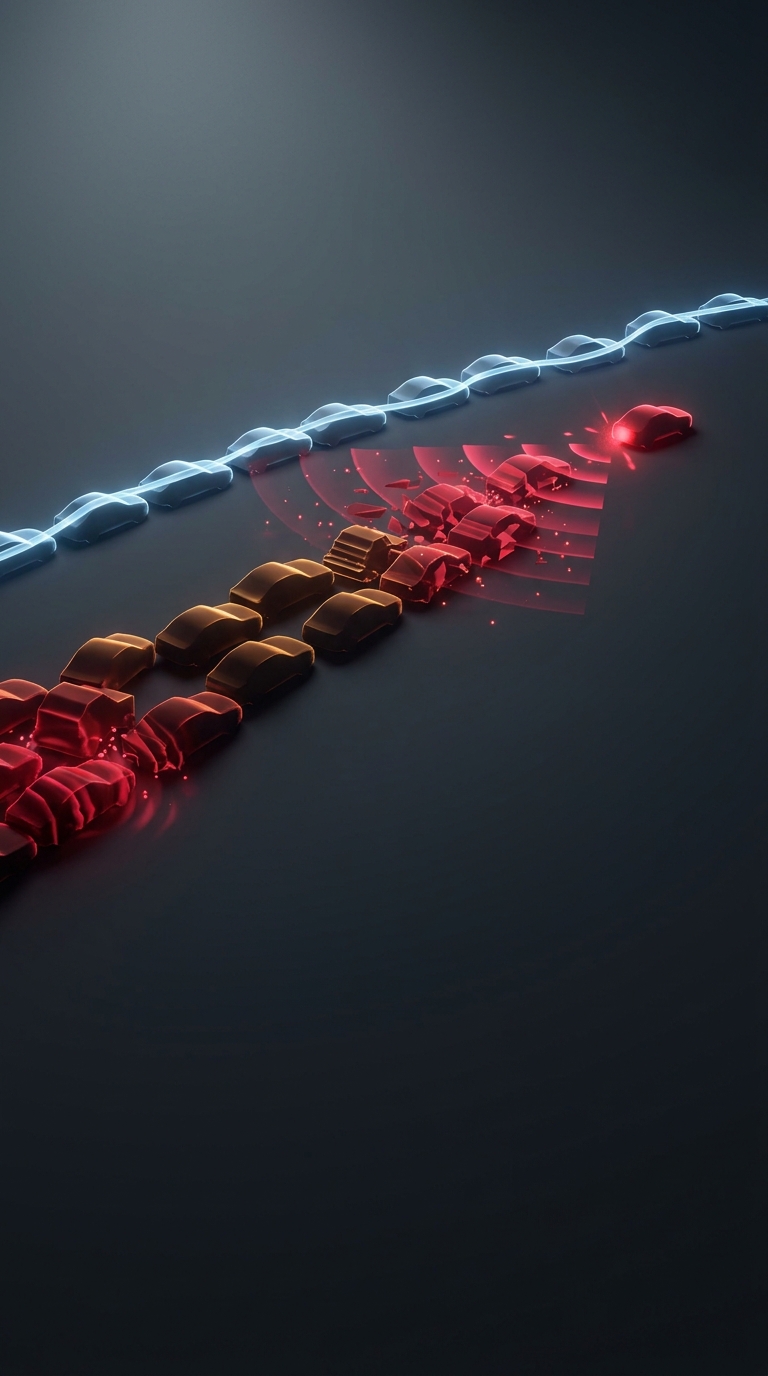
Each driver needs time to notice a change and respond. To restore a comfortable following distance, a driver may slow more than the car ahead did. The next driver then faces a larger speed change and may brake more sharply still. This pattern creates a stop-and-go wave: the slowdown travels backward through the line of traffic, while the cars themselves continue forward, often in short bursts.
The wave can outlast the original disturbance. By the time a driver reaches the back of the queue, the car that first slowed may be far down the road and moving normally again. From the roadside, the queue seems to have formed without a cause because its trigger has already disappeared.
Why the Queue Can Keep Re-forming
Once cars bunch up, drivers must leave extra space and accelerate cautiously to avoid closing that gap too quickly. The queue therefore releases unevenly: some cars speed up, while others are still braking or waiting. A new slowdown can form farther back, keeping traffic unstable even as the front of the original queue clears.
That is why a highway can remain congested after the apparent problem is gone. The bottleneck is not always a fixed place in the road; sometimes it is a moving pattern of drivers responding to one another.