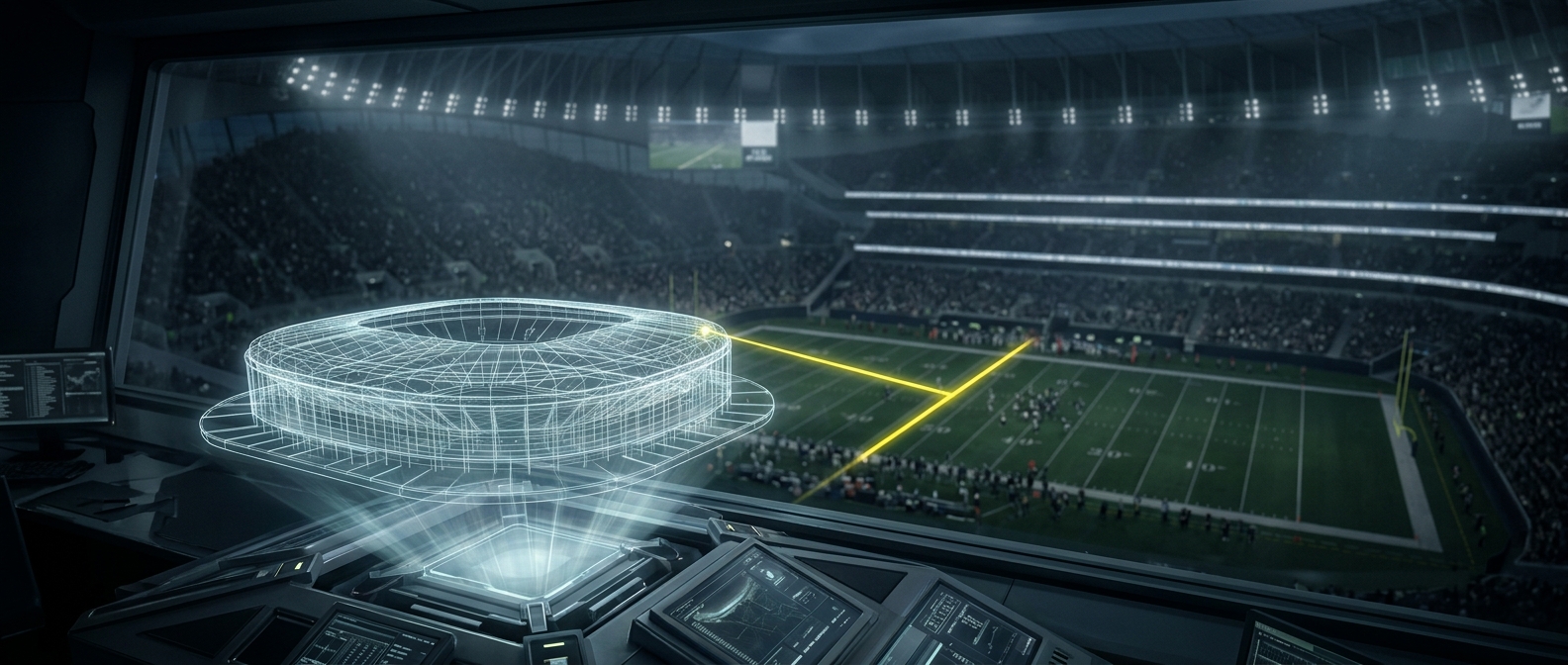
A virtual line anchored to the field
The yellow first-down line is added to the broadcast picture; it is not painted on the turf or projected onto the players. To make it look fixed in place, the system needs to know where the camera is pointing and how the field lies in the shot.
Sensors on the broadcast camera track its movement as it pans, tilts, or zooms. The field is mapped to known positions, so the system can calculate where a chosen yard line should appear in the current camera view. As the view changes, it redraws the graphic in the corresponding position and perspective. That is why the line can seem attached to the field rather than sliding across the screen.
Why players appear in front of it
Placing the line correctly is only half the trick. If the graphic were simply laid over the entire image, it would cover players, officials, and other objects. Instead, the system distinguishes foreground objects from the field and composites the picture in layers: the virtual line goes over the turf but behind the people crossing it.
This requires the broadcast image to be analyzed as it changes, frame by frame. The boundary between a moving player and the field can be complicated—a player may overlap the line, cast a shadow, or blend into similar colors—so the system has to keep the graphic aligned while preserving the visible foreground.
The result depends on two jobs working together: camera tracking keeps the line fixed to the field, while image processing keeps it from appearing on top of players. When both hold up during a fast-moving play, a graphic that exists only in the broadcast image reads like a stripe running across the real grass.