Why a long radio wave keeps pace with light
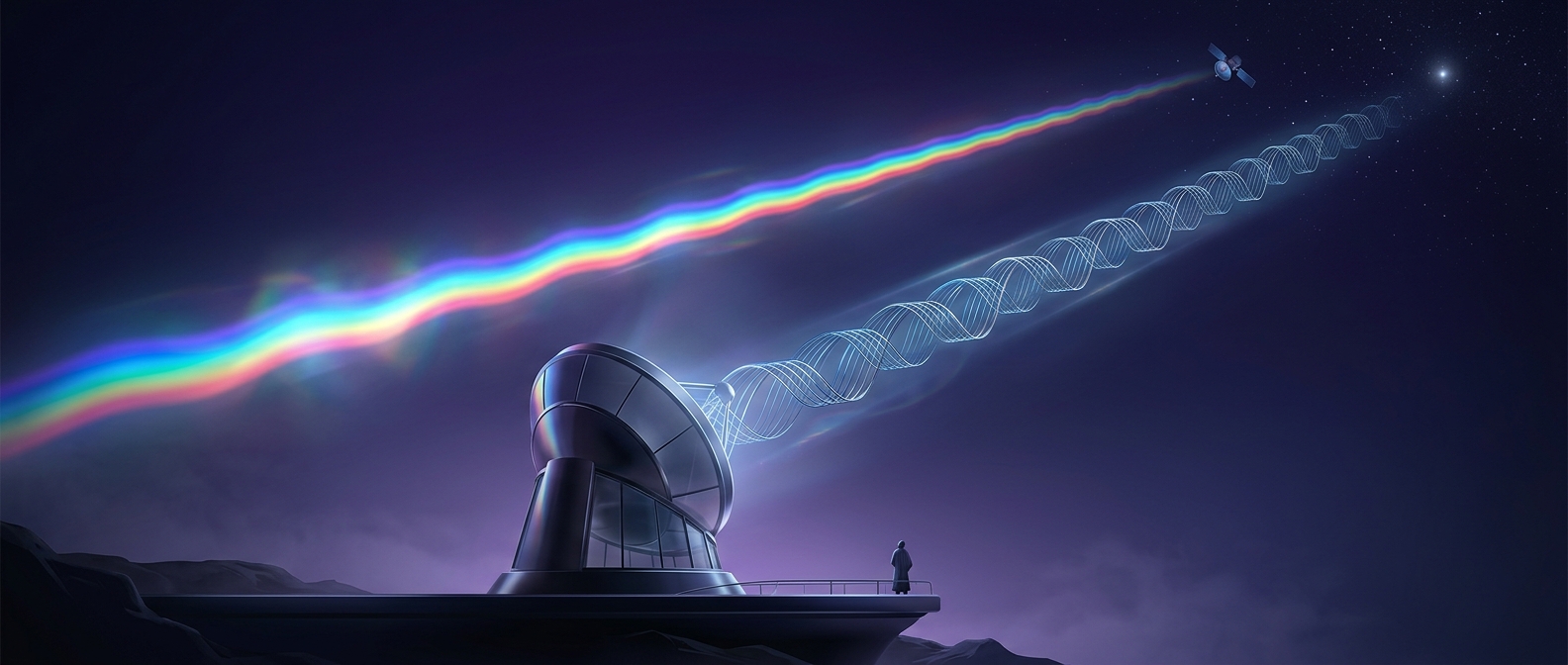
Radio waves and visible light differ in wavelength—the distance between repeating peaks—not in the kind of wave they are. Both are changing electric and magnetic fields traveling through space. In a vacuum, those fields propagate at the same fixed speed, regardless of how far apart their peaks are.
A longer wavelength means a lower frequency: fewer wave cycles pass a point each second. The two properties trade off so that wavelength multiplied by frequency gives the wave’s speed. Radio waves therefore have fewer, more widely spaced cycles, not a slower journey. Their energy per particle, or photon, is lower too, but that does not make them lag behind visible light.
The difference shows up in the equipment
Because radio wavelengths can be large, antennas often need to be shaped or sized to interact efficiently with them. Visible-light waves are tiny by comparison, so lenses, mirrors, and detectors work at much smaller scales. Wavelength also affects how waves behave around obstacles: long radio waves can bend around some barriers more readily than light, though buildings, terrain, and frequency all matter.
The shared speed has a practical consequence for communication: changing from radio to visible light does not, by itself, make a signal cross empty space faster. Engineers choose between them for other reasons, including how easily a signal can be generated, focused, received, or obstructed.