The pivot does the heavy work
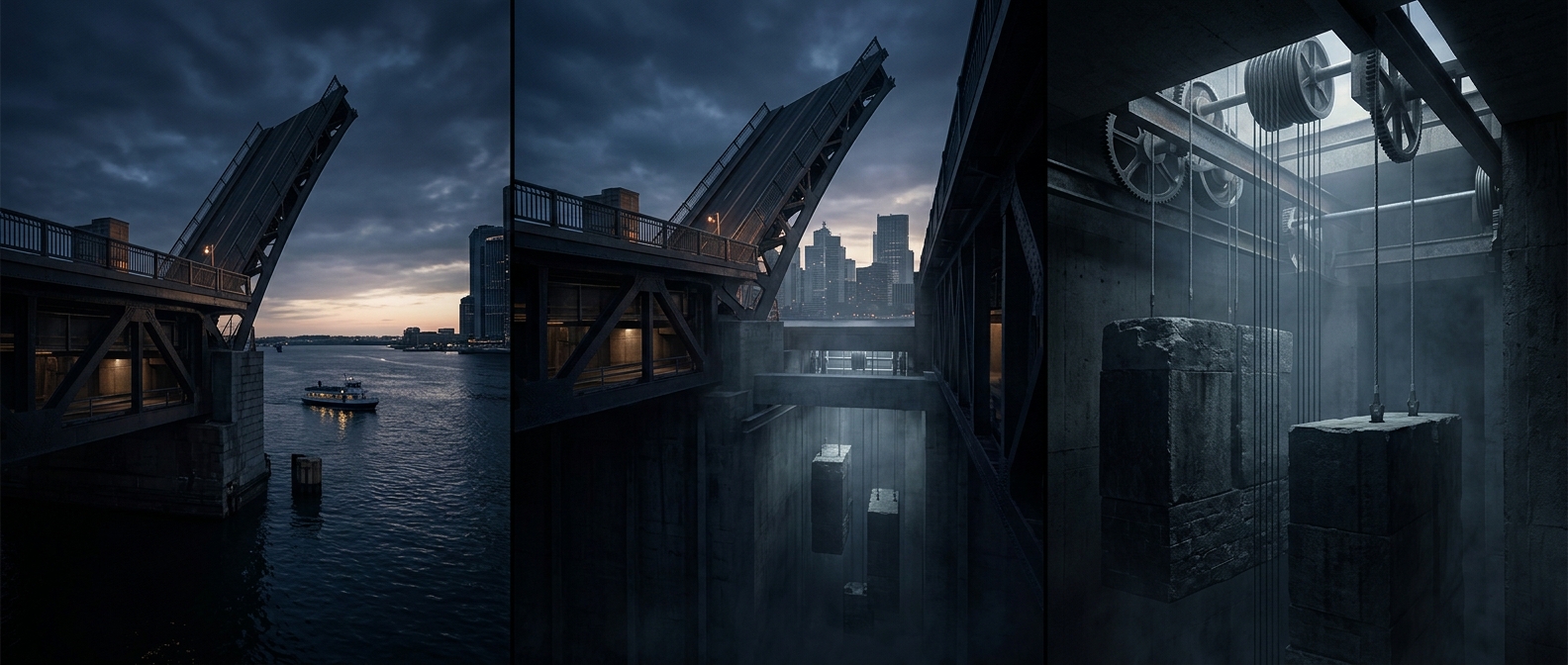
A bascule bridge is built like a giant seesaw. Its roadway, called the leaf, rotates around a horizontal shaft near one end. On the other side of that pivot, a counterweight moves in the opposite direction. It is often tucked into a chamber below the approach roadway, out of sight from drivers and pedestrians.
The counterweight is sized and positioned so its turning effect—its weight multiplied by its distance from the pivot—nearly offsets the roadway’s turning effect. That balance matters more than simply matching the two sides’ weights: a smaller weight farther from the pivot can counter a larger weight close to it.
Why a balanced bridge needs a motor
The counterweight does not open the bridge by itself. It makes the leaf much easier to rotate, while a motor and gears control the movement and overcome friction and other forces. The machinery is moving a nearly balanced lever, not hoisting the full roadway straight upward.
Balance must be close, not perfect. The bridge still needs enough drive to start and stop smoothly, and its moving parts must be secured when the span is down so traffic can cross safely. When the bridge opens, the counterweight swings down as the roadway rises, helping keep the loads on the pivot manageable.
A tradeoff hidden below the road
That counterweight saves power, but it takes substantial space and adds weight to the structure. Engineers must fit it, its travel path, and the operating machinery around the bridge’s supports and the waterway. The visible span may look like one enormous slab of steel; its motion depends on an unseen mass moving the other way.