Why a Driving Wheel Makes Aiming Awkward
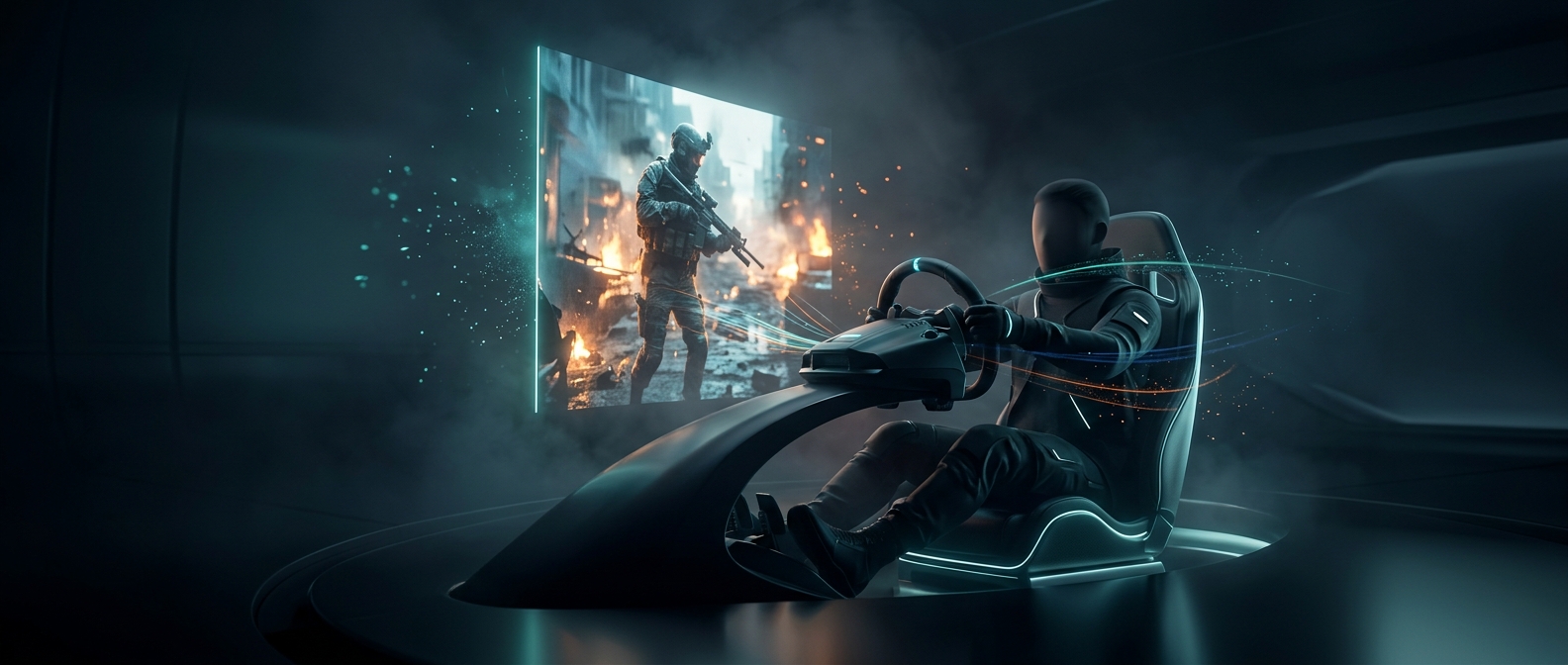
A steering wheel and a shooter’s aiming controls solve different problems. A wheel is built to represent a vehicle’s direction: turn it left or right, and the game reads how far it has rotated. A shooter, by contrast, usually expects small, quick movements on a thumbstick or mouse to steer the camera precisely across two dimensions—left and right, up and down.
That mismatch becomes obvious when the wheel is mapped to horizontal aim. A slight turn may move the crosshair too little to matter; a larger turn can sweep it past the target. To correct the overshoot, the player has to rotate the wheel back, then forward again. The motion is broad and deliberate, while aiming often depends on tiny adjustments made in a fraction of a second.
The Controls Have to Be Reassigned
A game designed for a wheel may not recognize it as a useful aiming device at all. When it does, the wheel’s inputs have to be assigned to shooter actions—through the game’s settings or the controller setup being used. One axis can steer the camera horizontally, but the wheel itself does not naturally provide the separate vertical movement a shooter needs. Other inputs may have to cover the remaining actions.
Sensitivity settings can change how much camera movement each degree of rotation produces, but they cannot make the wheel behave exactly like a thumbstick. Raising sensitivity makes broad turns more effective while also making fine corrections harder; lowering it gives more control at the cost of requiring more physical movement.
The challenge is not simply that the wheel is an unusual controller. Its shape encodes a different kind of motion. Aiming a sniper rifle asks for a delicate adjustment; the wheel answers with a turn meant to guide a car.