How a Flat Mark Sits on a 3D Surface
A game decal is a small texture—such as a muddy footprint, scrape, or splash—drawn over a surface that already exists in the scene. The wall or floor keeps its original shape; the decal supplies only the extra visual detail. That lets artists make one patch of a corridor look scuffed without building a new, individually modeled wall section.
The challenge is making a flat image look attached rather than pasted onto the screen. The game places the decal in the 3D world and maps its image onto the surfaces it touches. As the camera moves, the mark is rendered from the new viewpoint, so it stays in place on the architecture.
Why Surface Angle Matters
A decal that meets a wall at an awkward angle can stretch, smear, or spill onto a surface where it does not belong. Systems therefore account for the orientation of the receiving surface: a mark can be aligned to a floor, follow a sloping panel, or be rejected when a surface faces the wrong way. The result is still a flat graphic, but its placement and projection are adapted to the geometry beneath it.
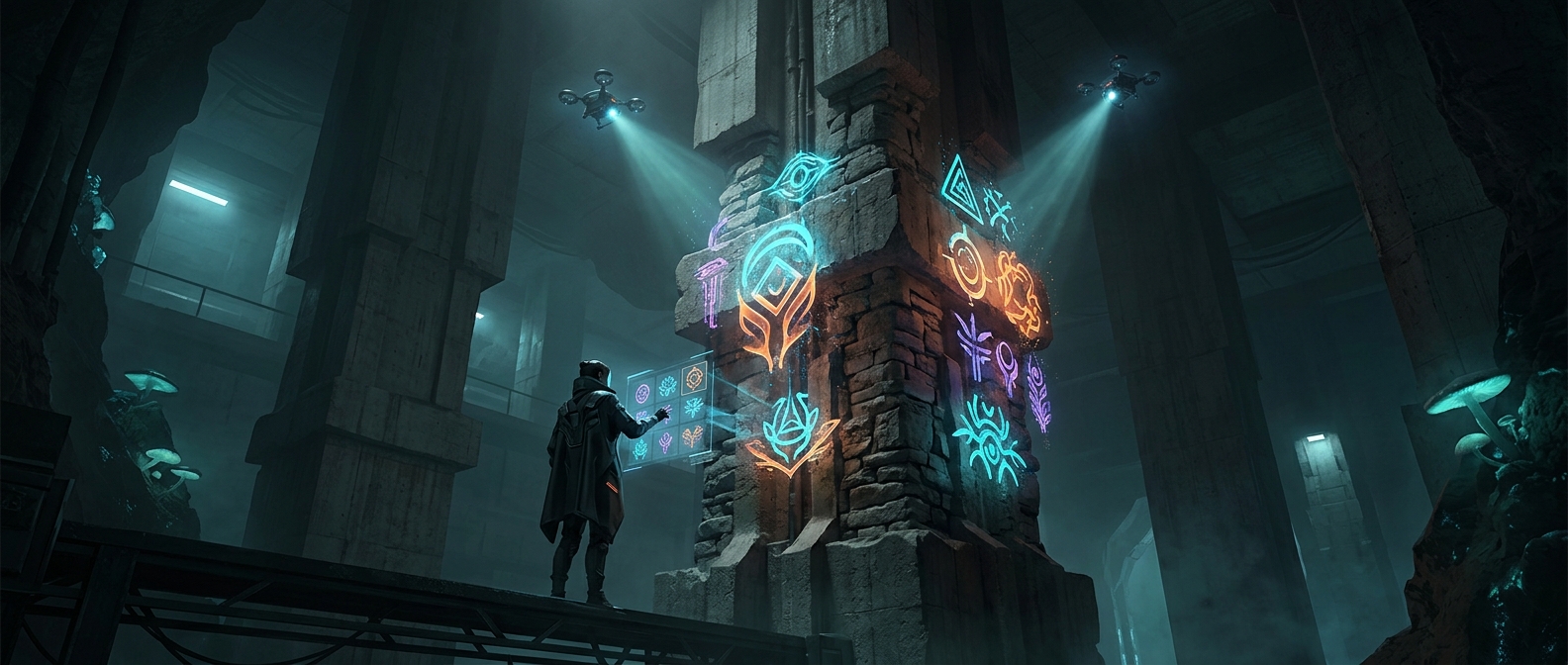
This is especially useful for localized wear. A designer can add grime around a vent or a streak beneath a pipe while leaving the surrounding material clean. Because the underlying geometry is unchanged, the same architectural piece can be reused with different marks, helping spaces feel less uniform without requiring a separate model for every variation.
The Tradeoff Behind the Effect
Decals are overlays, not physical changes: they do not create a dent or alter the outline of a wall. They work best when the detail is mainly visual and close to the receiving surface. That limitation is also their advantage. A small texture can make a familiar corridor feel used and specific, while the game continues to draw the same simple architecture underneath.