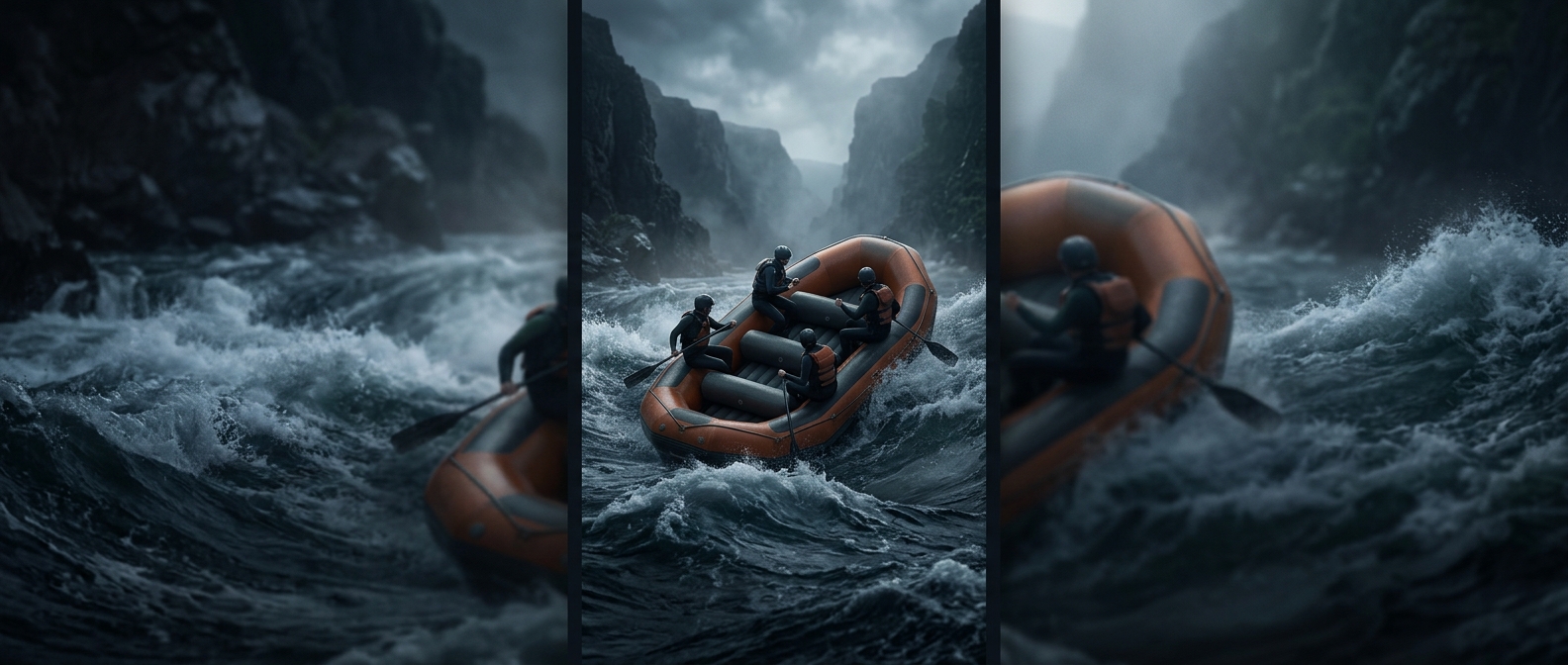
How an Inflatable Raft Turns a Rock Strike Into a Deflection
A rigid hull resists changing shape, so a sharp impact can concentrate force at one spot. An inflatable raft responds differently: its air-filled tubes compress and shift when they meet a rock. That movement can spread the impact across a wider area and help the raft slide past the obstacle instead of taking the full blow at a single point.
The raft is not simply a soft bag. Its inflated perimeter gives it enough shape to carry people and keep water out, while the flexible floor and sides can yield under pressure. Several separate air chambers also help the craft remain afloat if one section is punctured; the others can still hold air.
Flexibility Helps—but Has Limits
In rapids, the hull may scrape, bend, and rebound repeatedly as it passes over submerged rocks. That compliance—the ability to give under force—makes damage less likely than it would be with a hard, unyielding shell. It can also help the raft ride over uneven water rather than catch on every contour.
But flexibility is a survival strategy, not armor. A severe cut, abrasion, or puncture can still damage the raft, and its shape depends on staying properly inflated. Its useful trick is that ordinary impacts need not become rigid collisions: the hull can move with the obstacle, then recover its shape as the raft continues downstream.