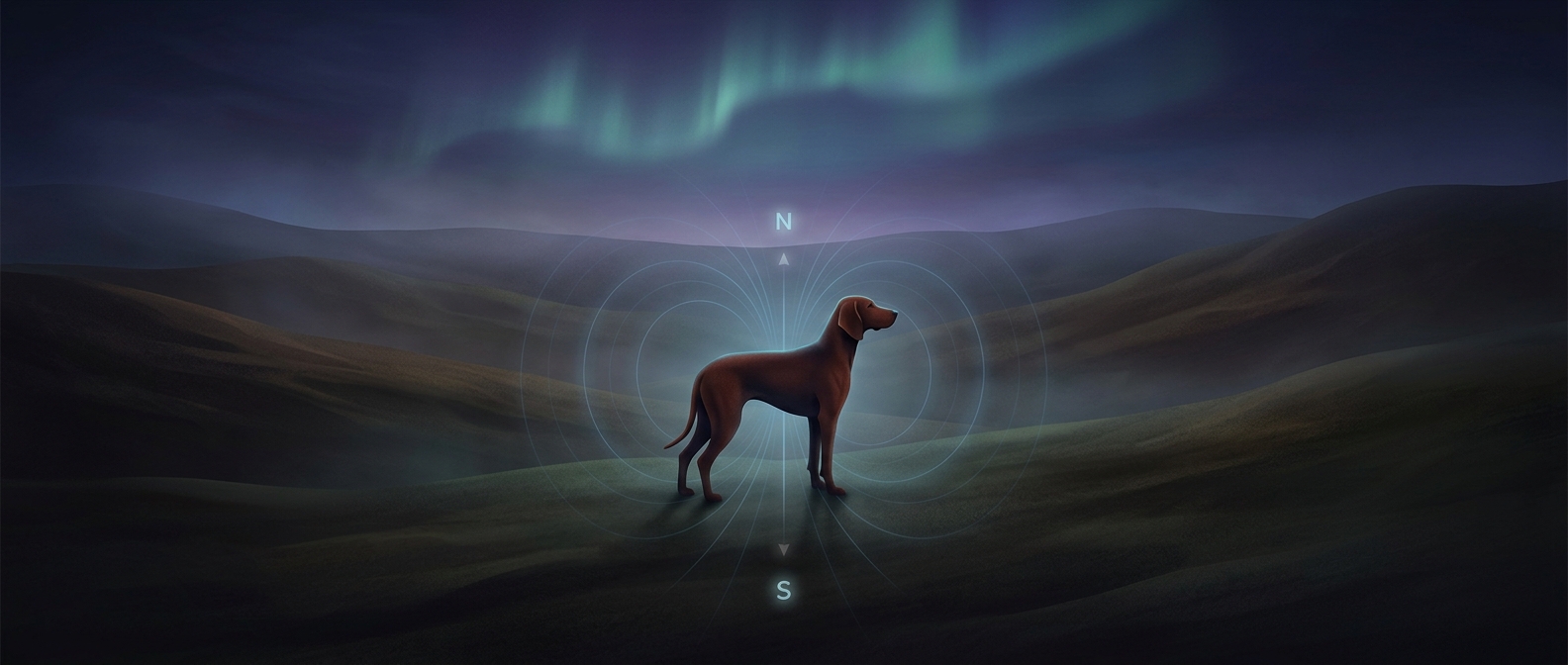
A compass-like pause before the squat
Some dogs appear to orient their bodies along Earth’s north–south magnetic axis while relieving themselves. In observations of dogs outdoors, researchers found this alignment was most noticeable when the planet’s magnetic field was relatively steady. When magnetic conditions shifted, the dogs’ orientations were less consistent.
That pattern is intriguing because Earth’s magnetic field is too weak for people to feel, yet some animals can use it as a navigational cue. Birds, for example, rely on magnetic information during migration. The dog observations suggest that dogs may also sense the field—or respond to some cue connected with it—but they do not establish exactly how a dog detects it.
A preference, not a bathroom compass
The finding describes a statistical tendency across many observations, not a rule for every trip outside. A dog may face another direction because of a nearby tree, a scent, the slope of the ground, a leash, or whatever has caught its attention. Circling and sniffing can help a dog choose a comfortable spot and check its surroundings; those familiar actions don’t prove that it is deliberately finding magnetic north.
The surprising possibility is that an invisible planetary signal could subtly influence an ordinary, highly focused moment. To test whether magnetic alignment matters to a particular dog, you would need far more than watching which way it faces once: the effect is small, and the dog’s everyday surroundings provide plenty of competing cues.