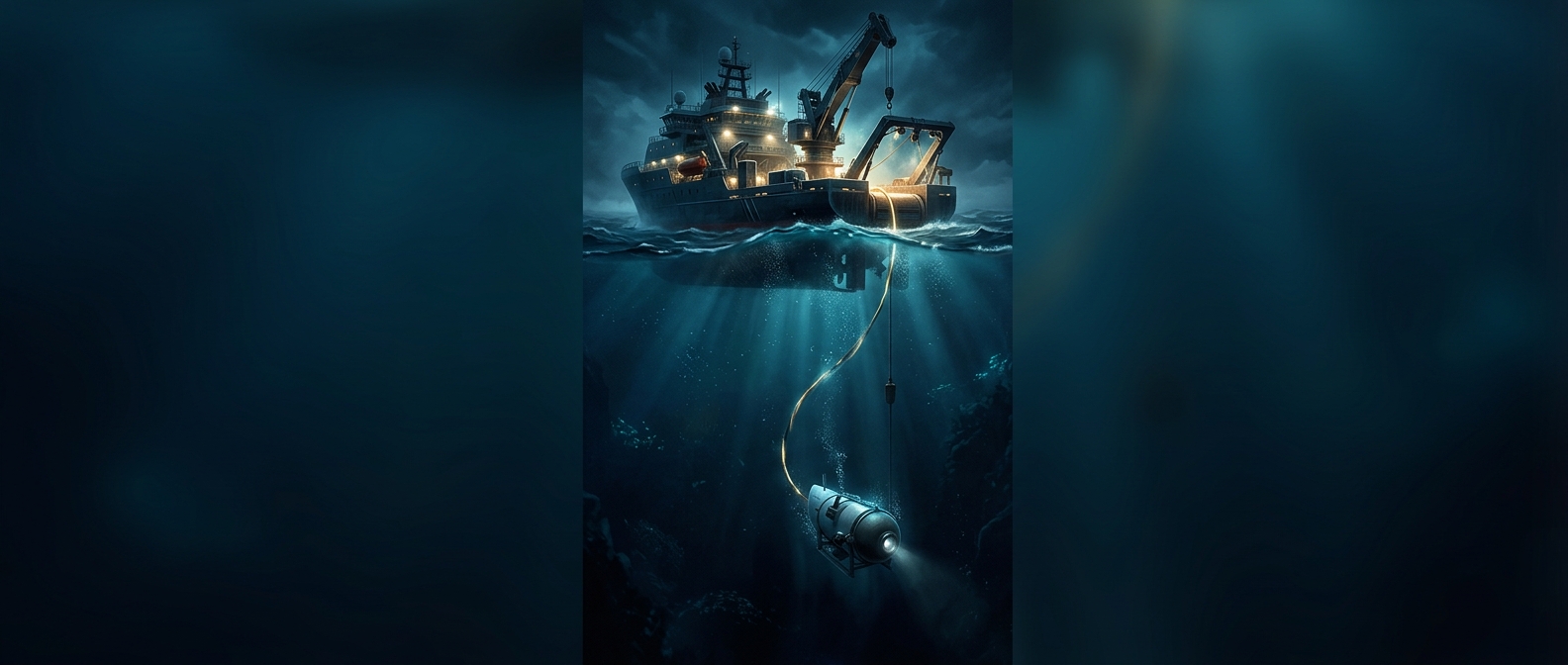
The pressure problem shapes the whole vehicle
Water pressure increases with depth because more water presses down from above. At great depths, that force pushes inward on every part of a submersible’s hull. To resist it, deep-diving craft use a compact pressure-resistant cabin, often a sphere: its curved surface spreads the load more evenly than a broad, flat wall would.
That strength comes with tradeoffs. A small, heavy craft is difficult to move quickly through the water and has limited room for fuel, batteries, equipment, and crew. It is built to descend, work, and return—not to travel long distances across the surface under its own power.
The ship is part of the diving system
A support ship carries the submersible from port to the remote area where it will dive. At the site, the ship’s crew lowers the craft into the water and later brings it back aboard, using lifting equipment designed for the vehicle’s weight and shape. Launch and recovery are delicate operations: the submersible must be guided clear of the hull and retrieved without being struck by the ship or battered against it by waves.
The ship also gives the dive a stable base. The team can prepare the craft, monitor the operation, and coordinate its return from the surface. Some systems maintain communication or track the submersible from the ship, though the details vary by vehicle and mission.
A deep-sea journey has two legs
The submersible’s specialized job begins after the ship has already done the long-distance travel. Once the dive ends, it returns to the surface and is recovered, ready to be serviced or sent down again. The support ship is not just transportation; it is what makes a short, high-pressure dive practical far from shore.