Why the Cube Has So Many Legal Positions
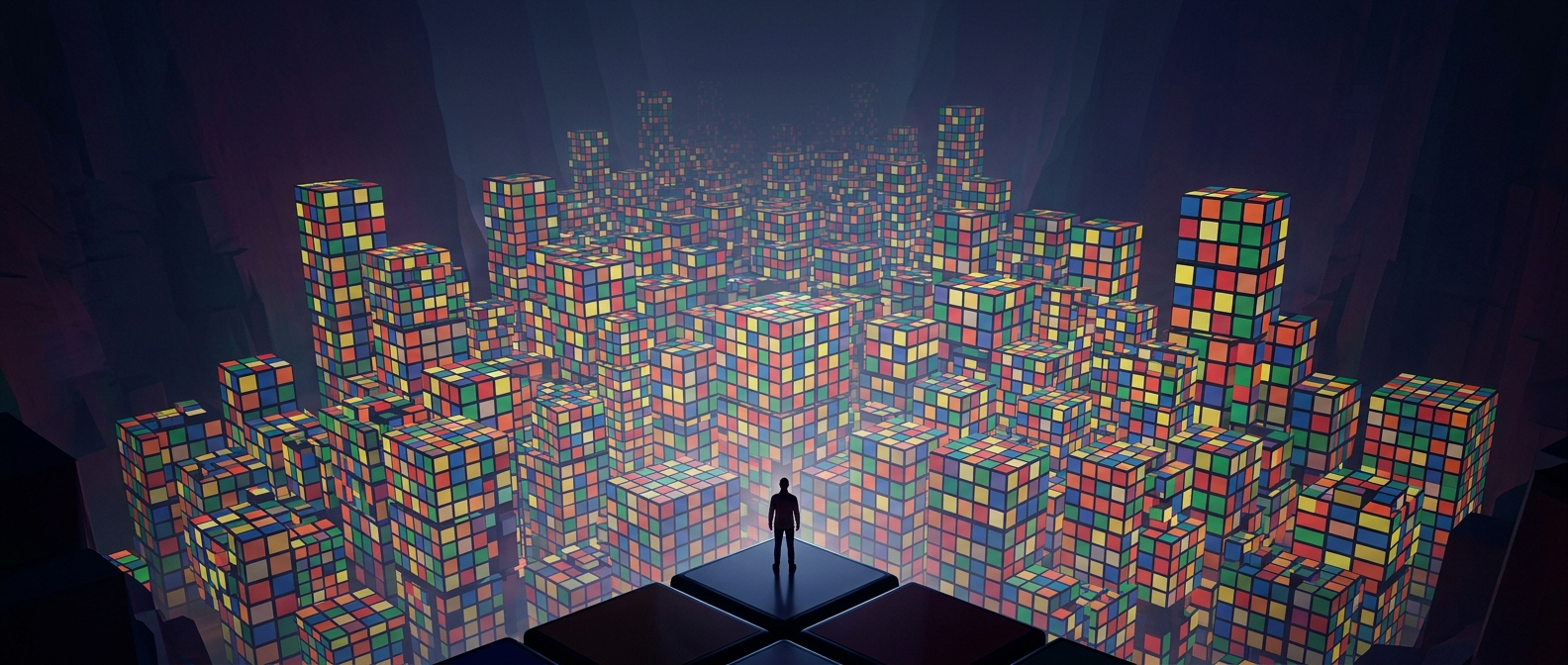
A standard Rubik’s Cube has 43,252,003,274,489,856,000 reachable arrangements—about 43 quintillion. The key word is reachable: the count includes positions you can create by turning the cube, not every way its colored pieces could theoretically be rearranged.
The count comes from choosing how to arrange the eight corner pieces and twelve edge pieces, then accounting for how each can be twisted or flipped. But those choices are not completely independent. Twist the corners in a sequence of turns, for example, and their total orientation must still obey a constraint; the same is true of flipped edges. There is also a parity rule: the corner and edge permutations must have matching even-or-odd status. These restrictions rule out many arrangements that look imaginable but cannot result from ordinary turns.
A Scramble Is One Point in a Vast Space
Each face turn moves pieces through this constrained system without changing which pieces the cube contains. A scramble is simply a route from the solved position to one other legal position. Reverse the turns, and the cube returns to solved—so the enormous count describes not separate cubes, but the different states one cube can occupy.
That distinction is why solving methods can work without memorizing every possible scramble. They use patterns and sequences of turns to guide pieces toward their correct places while preserving progress already made. The number of possible positions is immense, but every legal one remains connected to the solved cube by turns you can undo.