Why the cube’s possibilities grow so quickly
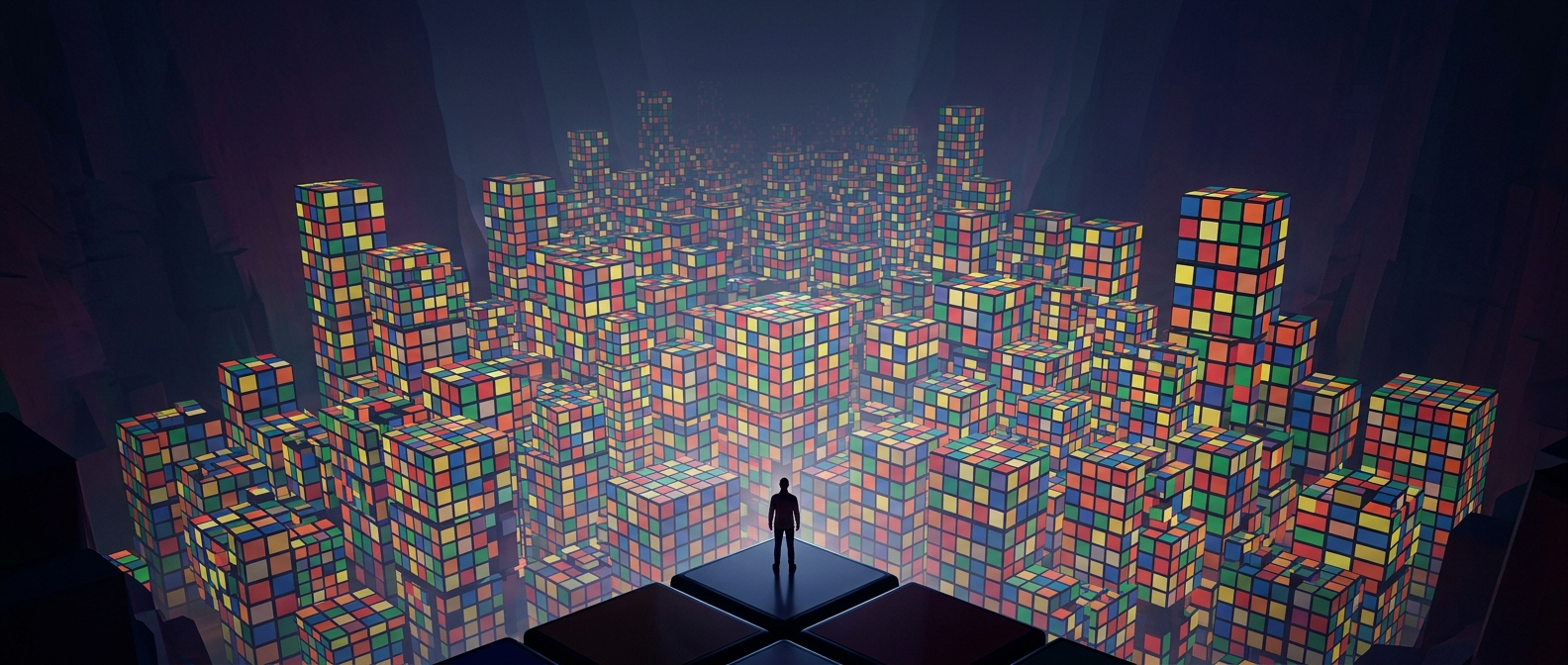
A standard Rubik’s Cube has 20 movable pieces: eight corner pieces and 12 edge pieces. Each can occupy different positions, and most can also be oriented in more than one way. Combine those choices and the number of reachable arrangements becomes enormous: about 43 quintillion.
But the pieces cannot be shuffled arbitrarily. A corner can only land in a corner slot, an edge in an edge slot, and the cube’s turning rules impose further constraints. For example, twisting just one corner while leaving everything else untouched is impossible through ordinary moves. These restrictions are why the count refers to states the cube can actually reach, not every imaginable rearrangement of colored squares.
A huge search space, built from simple moves
Each turn changes only part of the cube, yet those local changes interact. A turn moves several pieces together; later turns can move them back, redirect them, or disturb pieces already placed. The challenge is to find a sequence that brings every piece home without undoing earlier progress.
That scale helps explain the difference between solving by trial and error and solving with a method. A person does not need to inspect every possible state. Instead, a method uses patterns—such as positioning a small group of pieces while preserving work already done—to narrow the choices at each stage. The cube’s staggering count comes from all the combinations available; its solvability comes from the structure of the moves.