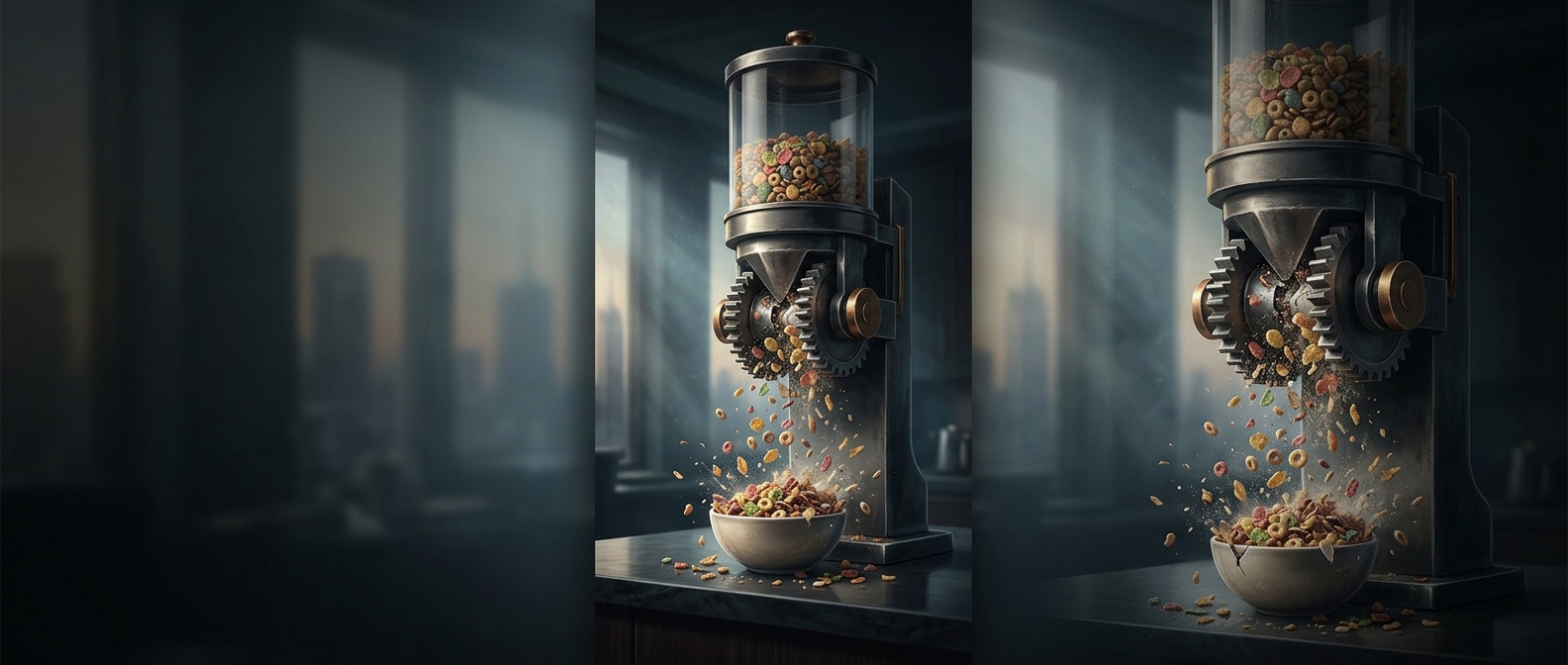
How a cereal dispenser turns flakes into crumbs
A rotating hotel cereal dispenser meters cereal a little at a time. Inside, a knob turns a wheel or chamber that carries cereal toward an opening. As the mechanism moves, flakes can get pinched between its moving parts and the dispenser’s casing. Each turn may break some of them; repeated use can leave a layer of crumbs and powder in the bowl.
Why flakes are especially vulnerable
Breakfast flakes are thin and brittle. They can bend only so far before snapping, and pressure concentrated along an edge can break them more easily than a broad, gentle push. In a dispenser, flakes may be squeezed, rubbed against one another, or caught at the outlet. The result depends on the dispenser’s design and how full it is, but the basic problem is the same: a mechanism built to move cereal can also put force on it.
Portion control has a tradeoff
The turning mechanism makes it possible to serve cereal without leaving an open container and scoop beside the breakfast line. But it does not handle every shape equally well. Small, sturdy pieces tend to pass through more easily; large, airy flakes are more likely to snag and fracture. So the fine dust at the bottom of a bowl is not necessarily a sign that the cereal began as crumbs—it may be the residue of flakes being pinched and jostled on their way out.