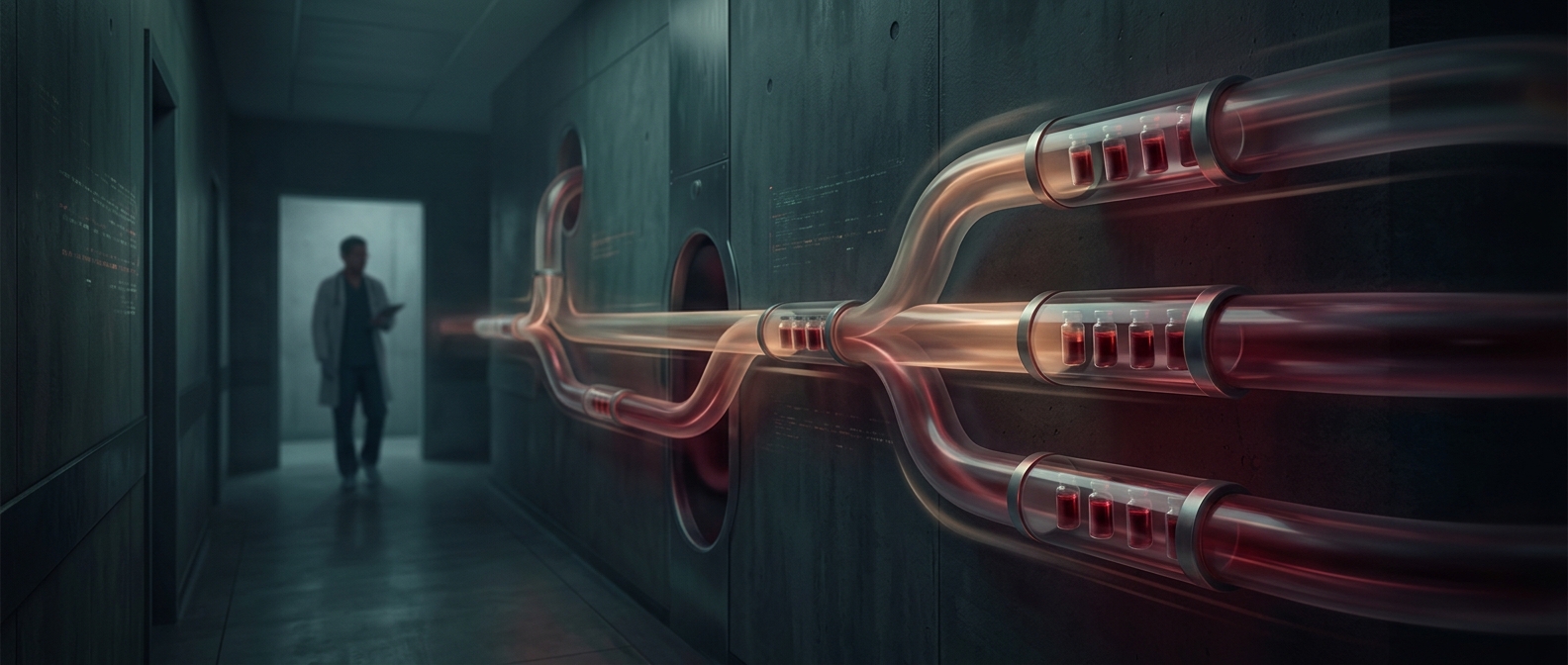
A hospital’s hidden delivery network
Behind the walls, a hospital pneumatic-tube system works like a small, automated postal service. Staff place specimens in a rigid carrier, close it, and send it into a network of pipes. At junctions, automated switches direct the carrier toward the laboratory or another destination. The system’s controls track where carriers are sent and help prevent them from being routed to the wrong station.
Speed depends on more than distance
A tube can cross a large building faster than a person walking the same route, but the journey is not simply a straight shot. The carrier may pass through bends, switches, and shared sections of pipe, while other deliveries move through the network. Air pressure has to be controlled so the carrier travels without arriving too abruptly.
That matters because a blood sample is not just a package. Rough handling can damage blood cells or otherwise affect some test results. Hospitals therefore validate their systems for the kinds of samples and tests they plan to send, and may use different settings or routes to limit jolts. A tube is not suitable for every specimen or every situation; samples needing special handling can still travel by hand.
Faster arrival can change the lab’s workflow
Once a carrier reaches the laboratory, staff can begin processing the sample sooner, reducing the time spent waiting for a handoff. The tube does not perform the test or eliminate the need to identify and handle the specimen carefully—it shortens one link in the chain between collection and analysis.
The useful engineering trick is that the pipes turn empty wall space into a shared transport route. A small carrier can make repeated trips through it, while hospital staff stay available for work that cannot be automated.