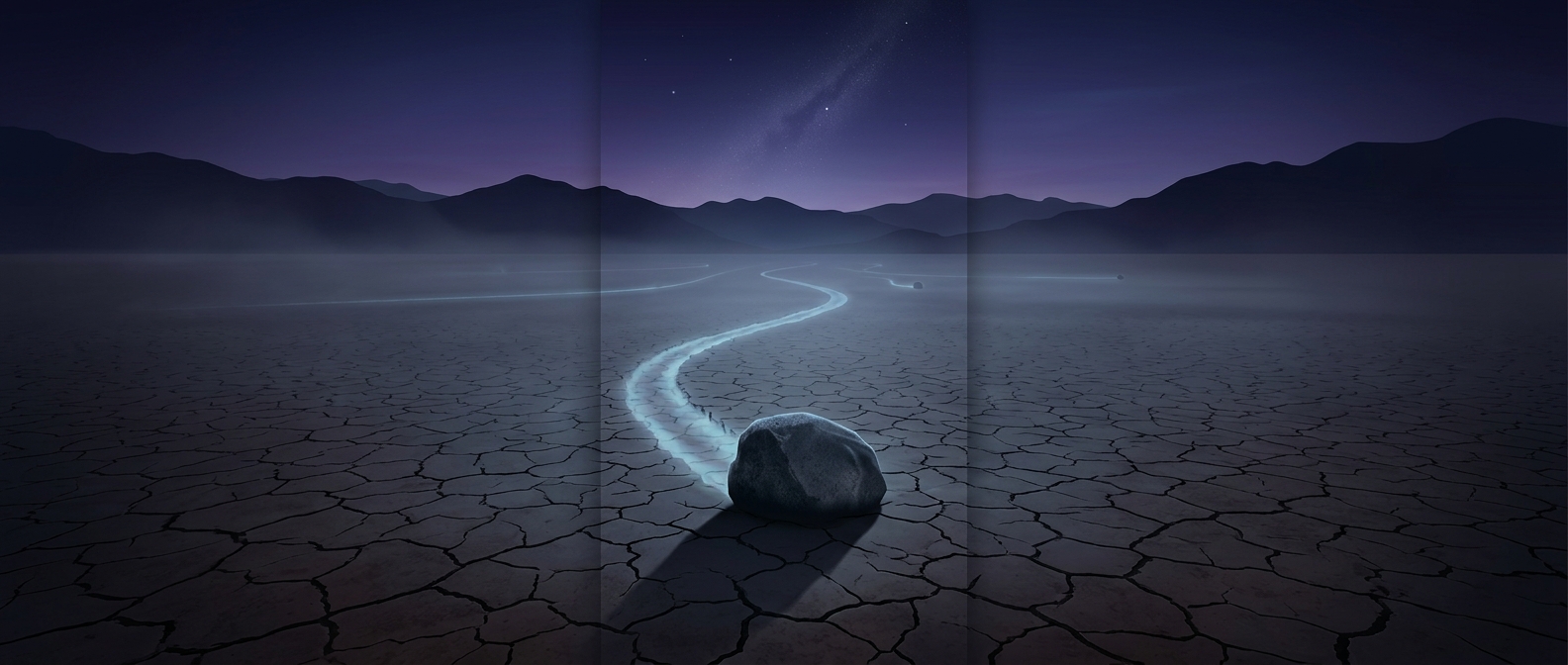
How a thin sheet of ice can move a heavy rock
A rock crossing a dry lake bed can look as if it moved by itself. The motion is real, but it takes a particular combination of weather and ground conditions. After rain or snowmelt leaves a shallow layer of water on the flat basin, cold nights can freeze that water into thin, floating sheets of ice.
When the sun warms the basin, the ice begins to break into broad panels. A light wind can push those panels across the shallow water. If a panel catches against a rock, it can nudge the stone along the slick, wet surface. The wind does not need to shove the rock directly; the ice acts like a moving hand, spreading its force across the stone.
The trail is a record of the trip
As the rock slides, it presses into the soft sediment below, leaving a groove. Later, the water drains or evaporates and the mud dries, preserving that track across the otherwise smooth basin. A rock may travel in a straight line, curve, or change direction as the wind shifts and the ice breaks or turns.
The conditions are fleeting: the bed must be wet enough for movement, cold enough for ice to form, and exposed to wind while the ice is still able to carry force. That is why the stones can sit still for long stretches, then leave fresh trails after a brief spell of suitable weather. The striking part is that a delicate, temporary sheet of ice can make a heavy rock’s journey visible long after the ice itself has vanished.