A board built for changing totals
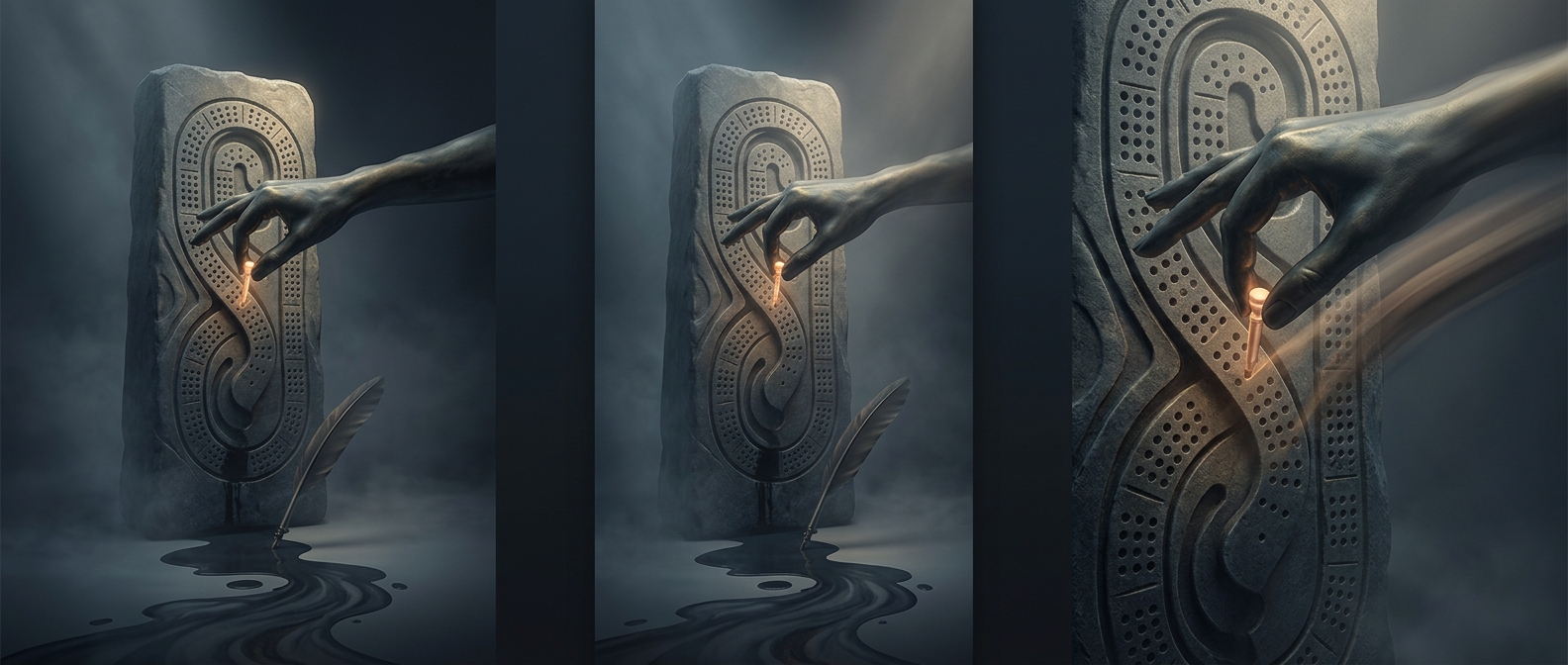
Cribbage scoring happens in bursts. A player may earn points for a combination of cards during play, then score another hand after the round ends. Instead of pausing to calculate and rewrite a running total each time, players move pegs along a board drilled with numbered holes.
Each player uses two pegs. The rear peg marks the previous total; the player moves it ahead of the other peg by the number of points just earned. The pegs leapfrog, so the leading peg always shows the current score and the trailing one preserves the last checkpoint. That makes it easy to see how much was added—and to catch a counting mistake before it carries into later turns.
Scoring stays in the flow of play
The board is especially useful because cribbage awards points for several kinds of combinations, such as matching ranks or making a run of consecutive cards. Players can score while cards are being played, not only at the end of a hand. Each small gain can be pegged immediately, keeping the running total visible to everyone.
The pegs do more than replace pencil and paper: they turn scorekeeping into a quick physical action. A player can move a peg and continue the game, while the board preserves the score’s recent history. When points arrive one combination at a time, that little leapfrog is what keeps the count from becoming another round of arithmetic.