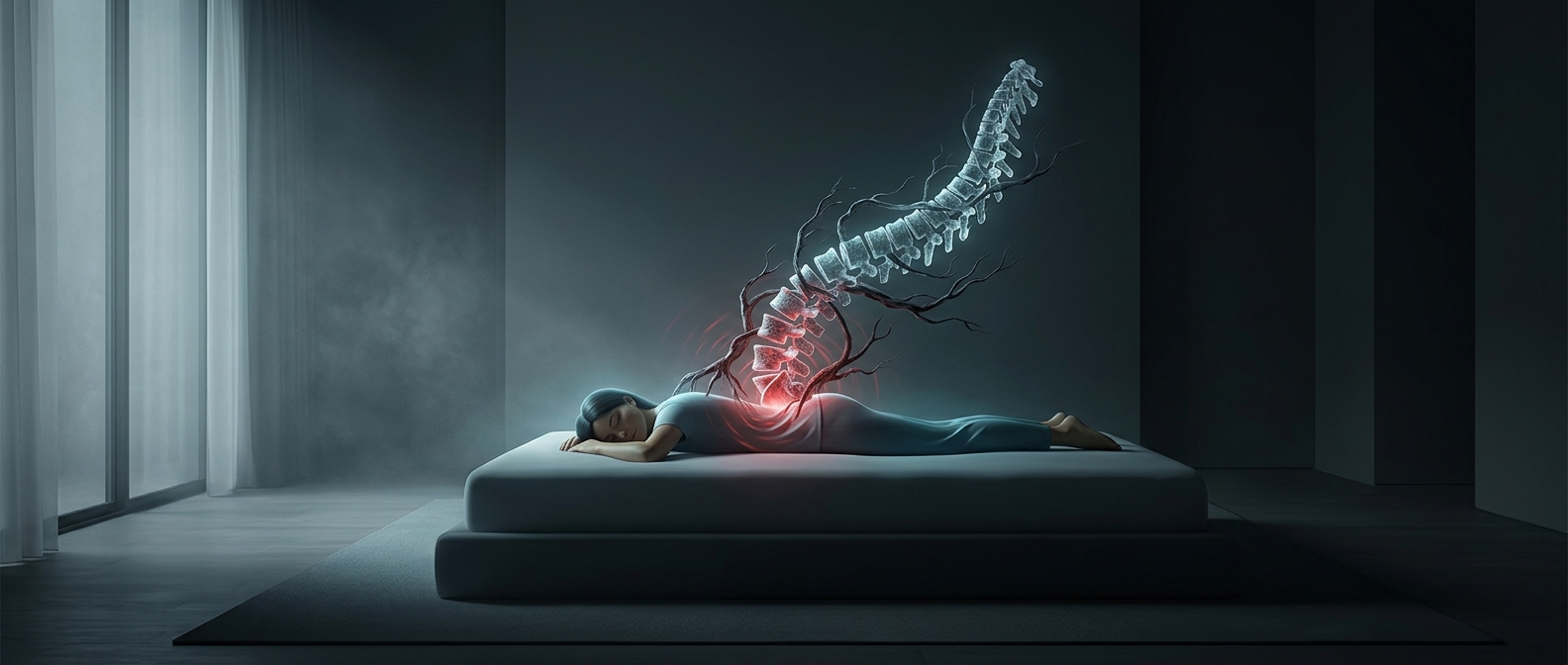
Why a night-long posture can bother your back
When you lie face down, your body rests against the mattress rather than settling into the supported curve it has when you stand. Depending on your build and the mattress, your pelvis may sink or press forward while your lower back stays arched or shifts position. The small joints and muscles around the spine then spend hours adapting to that posture instead of moving and relaxing as they normally do.
The neck adds another sustained twist: to breathe, most stomach sleepers turn their head to one side. That rotation can also carry tension into the shoulders and upper back, making the whole torso feel stiff when you first get up.
Why it may feel worse in the morning
During sleep, you make fewer deliberate posture changes than you do while awake. A position that seems comfortable at first can therefore keep loading the same tissues for a long stretch. Afterward, muscles may feel tight and joints may be temporarily sensitive; moving around often helps them loosen. Morning soreness does not, by itself, mean the spine has been damaged.
Small changes can reduce the strain
If you prefer sleeping on your stomach, a thinner or no pillow under your head may reduce how far your neck has to bend. Some people also find that placing a thin pillow under the pelvis eases pressure on the lower back, though comfort varies. Changing to side- or back-sleeping can reduce the need to keep the neck turned, but a position is useful only if you can sleep comfortably in it.
If pain is severe, persists through the day, or comes with symptoms such as weakness or numbness, seek medical advice rather than assuming sleep posture is the only cause.