Why the train went through the station
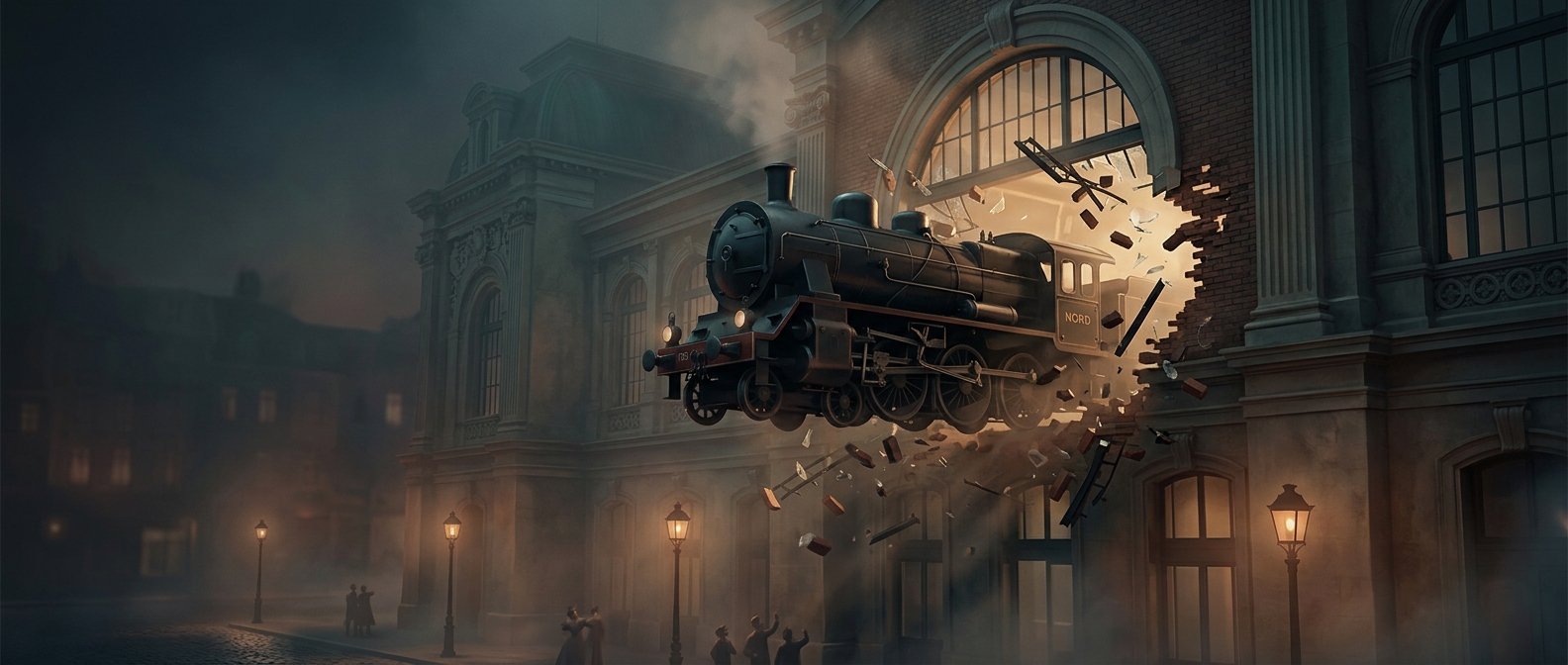
The scene unfolded at Paris’s Montparnasse station in 1895, when an arriving train ran past the end of its track and burst through the station’s outer wall. Its locomotive ended up jutting over the street below. The crash was not simply a case of a wall failing: the train still had substantial forward motion when it reached the track’s end.
A terminal platform is a stopping area, not a long, clear runway. At the end of the rails, buffers—spring-loaded stops meant to absorb some impact—can slow a train that reaches them gently. They cannot reliably arrest a heavy train moving too quickly. The train’s momentum carries it forward, and the buffers, track supports, and anything beyond them must take the force in a very short distance.
A station built around a dangerous boundary
At Montparnasse, the track ended inside a busy building. Once the train passed the buffers, it crossed the concourse and struck the façade. The wall was the last barrier between the platform and the street, not a structure designed to catch a full-size locomotive at speed. The engine broke through and came to rest partly suspended above the road.
The striking image makes the underlying safety lesson visible: a buffer is a final safeguard, not a substitute for stopping in time. In a terminal, every layer beyond the rails—the stopping system, the building, and the street outside—can become part of the crash if the train reaches the end with too much momentum.