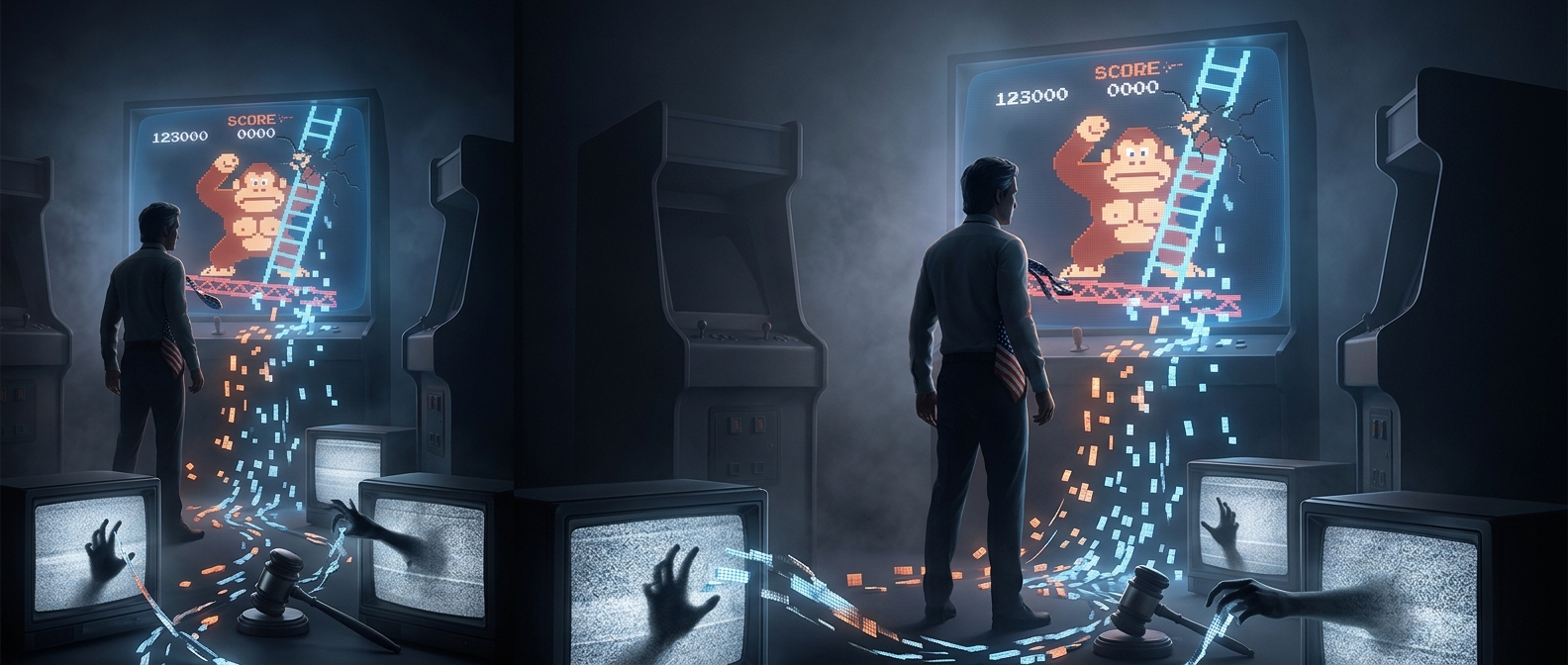
Why Donkey Kong’s 22nd level becomes unwinnable
Donkey Kong’s famous “kill screen” is not a hidden final boss or a special ending. It is a failure caused by the game’s own level-and-timer arithmetic. As players advance, the game raises the difficulty and calculates how much time they have to finish each stage. But the timer uses a limited-size number: once calculations exceed the range it can represent, the value wraps around instead of growing normally.
By the 22nd level, that wraparound leaves Mario with too little time to complete the stage. The countdown runs out, and the game kills him. The precise experience can depend on the arcade version, but the essential problem is the same: progress eventually produces a stage the game’s timer makes impossible to survive.
A limit built into the game’s design
Arcade games were made to run on hardware with tight memory and processing limits. Designers could save space by using small numbers for counters and timers, and they had little reason to expect ordinary play to reach levels far beyond the intended challenge. In Donkey Kong, the level progression keeps going even after the timer calculation stops behaving sensibly.
That mismatch turns skill into a trap. A player can master the jumps, climb, and hazards, yet still lose because the game no longer allows enough time to finish. The kill screen is therefore both a software limit and a competitive milestone: reaching it proves how far a player can push the game, while also revealing where its underlying arithmetic finally gives way.