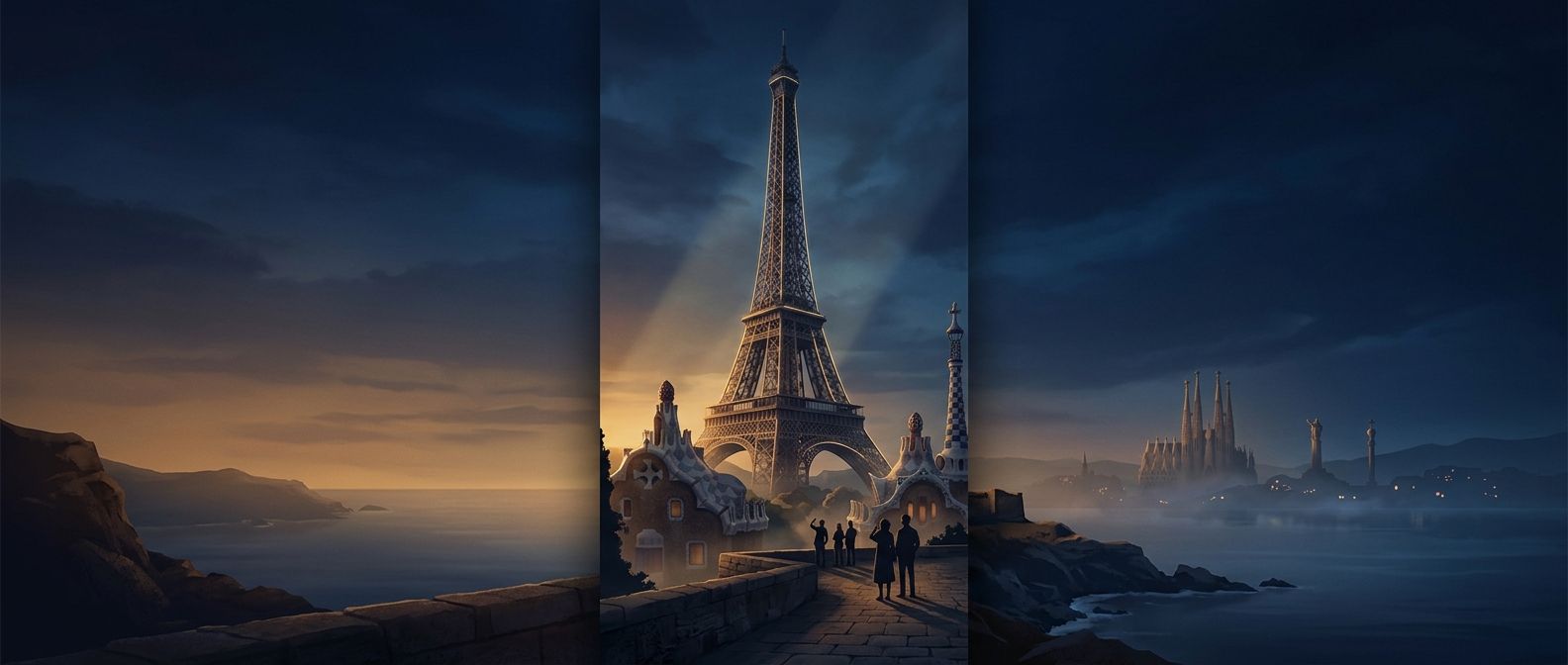
Barcelona’s Exhibition Had a Chance at Eiffel’s Tower
Before the Eiffel Tower became Paris’s signature landmark, its design was considered for Barcelona’s 1888 Universal Exposition. The proposal came from engineer Gustave Eiffel’s company, which was developing a vast iron tower as a public spectacle. Barcelona’s organizers turned it down; the design was not built there.
That refusal was not simply a choice between two cities’ tastes. An exposition site had limited space and money, and its organizers had to decide which buildings and attractions would best serve their event. A tower of unprecedented height would dominate the grounds—and demand a substantial commitment for a structure whose long-term purpose was not yet clear.
Paris Gave the Design a Different Job
A year later, Paris accepted a tower proposal for its 1889 exposition, held to mark the centenary of the French Revolution. There, the tower was not just another attraction: it was intended to be the exposition’s great entrance feature and a demonstration of what iron engineering could accomplish.
Its open lattice of iron parts helped make such height possible without creating a solid, heavy-looking mass. But the structure’s scale and appearance also made it contentious. The same qualities that could seem too imposing for one exposition could become the centerpiece of another.
A Temporary Exhibit Became Permanent in the City’s Imagination
The tower was initially conceived as a temporary structure, with a planned lifespan of about 20 years. Its later usefulness for scientific experiments and communications helped give Paris reasons to keep it. What began as an exhibition project therefore outlasted the event it was built to serve.
Barcelona’s rejection did not make the tower inevitable, and Paris’s acceptance did not guarantee its lasting fame. The striking turn is that an engineering design considered unsuitable for one city’s exposition became the feature that millions now associate with another.