How a dentist’s drill stopped relying on muscle
Before electric motors, a dental drill’s cutting tip still needed to spin, but the dentist had to provide that motion. Hand-powered devices demanded steady effort; foot-powered drills shifted the work to a treadle, much like operating a sewing machine. Either way, keeping a small bit turning while controlling it against a tooth made the dentist’s own rhythm part of the procedure.
What electricity changed
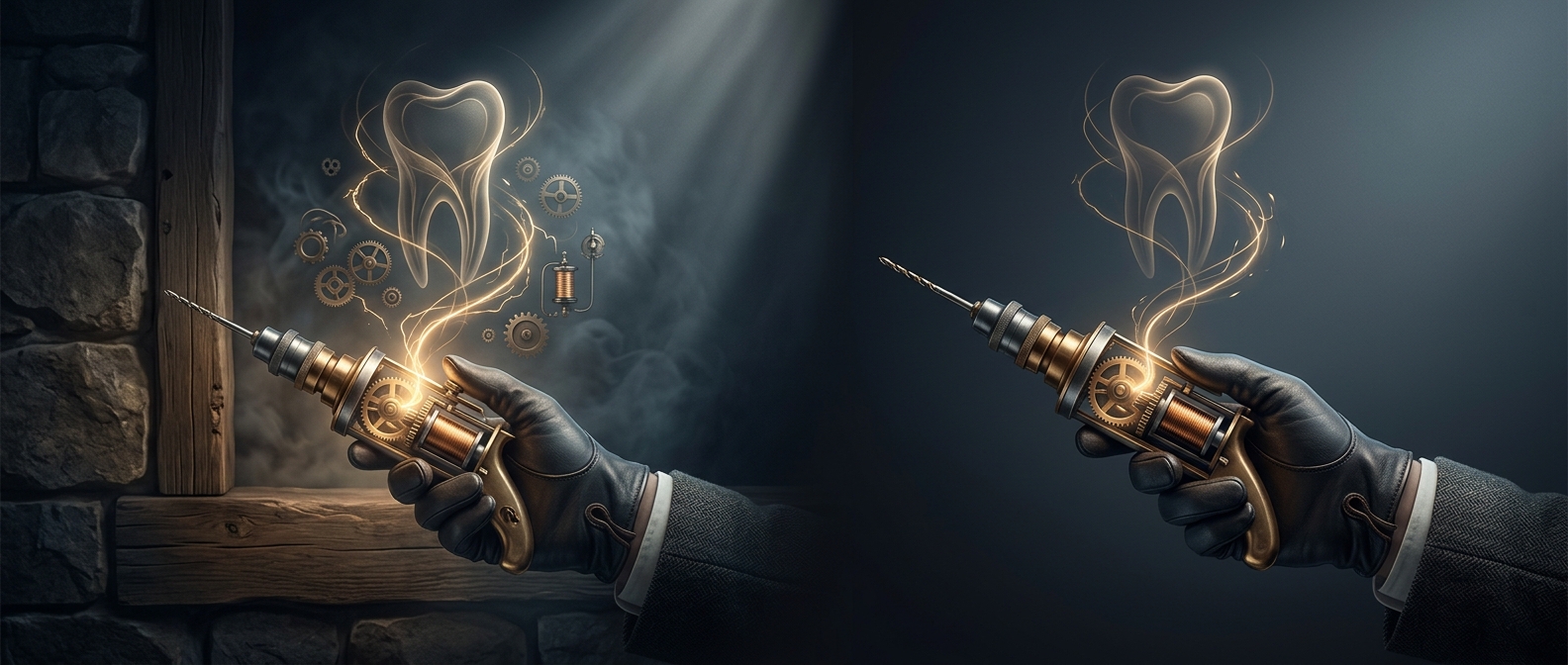
In 1875, George F. Green patented an electric dental drill. Its motor supplied the rotation, freeing the dentist from continuously powering the instrument by hand or foot. That mattered not because electricity changed what a drill bit did—it still cut by spinning—but because it separated the power source from the operator’s body.
With the motor doing the repetitive work, the dentist could concentrate more directly on positioning and guiding the instrument. The change also made powered drilling less dependent on a practitioner’s ability to maintain a steady pace with a hand crank or treadle. It was an early example of a broader shift in dentistry: using machinery to take over physically repetitive tasks while leaving judgment and control with the clinician.
A motor was only the beginning
An electric motor could make the drill spin, but it did not by itself make dental work effortless or comfortable. The instrument still had to be handled precisely, and the motor, drill bit, and their connection had to work together as a usable tool. The lasting significance of Green’s invention is therefore not that it instantly created the modern dental handpiece, but that it introduced a new arrangement: electricity supplied the motion, while the dentist directed it.