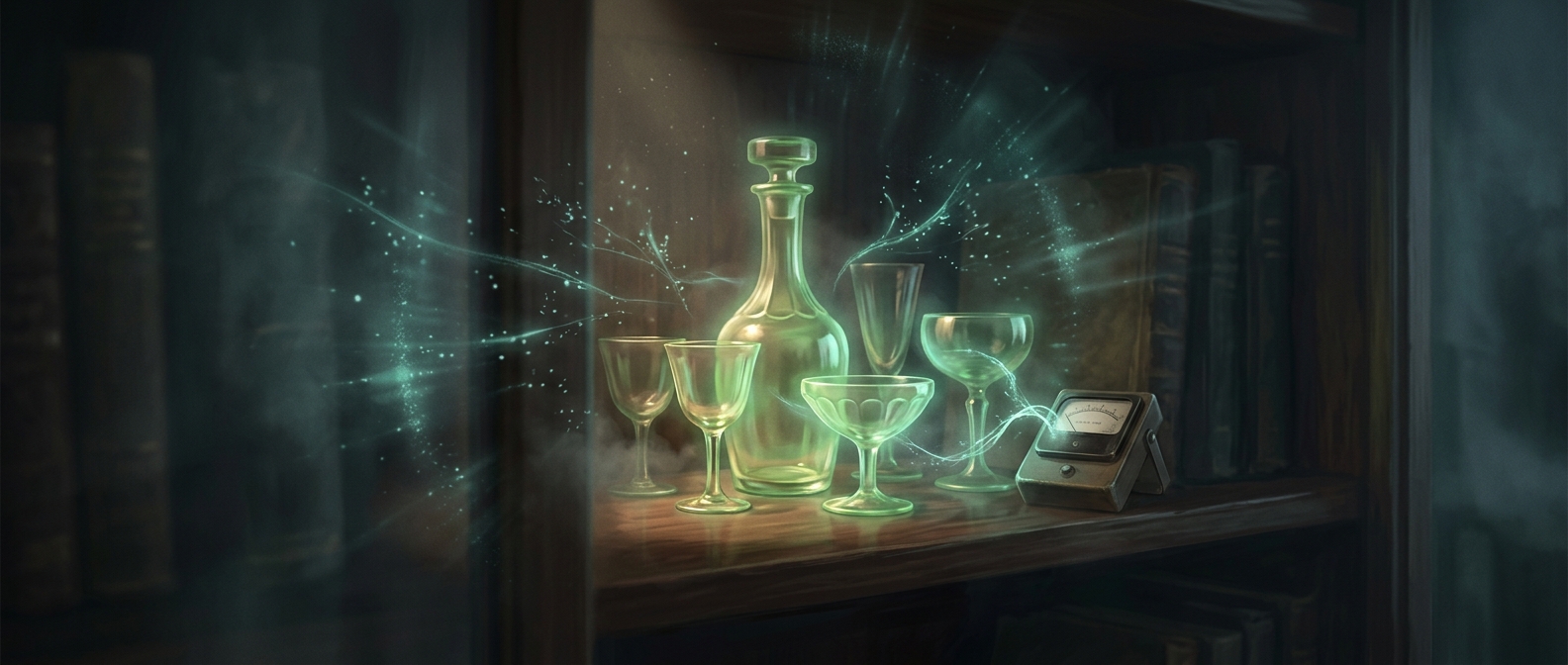
Why the glass gives a Geiger counter something to detect
Uranium glass contains a small amount of uranium mixed into the glass. Uranium atoms are unstable: over time, some decay into other elements, releasing radiation as they do. A Geiger counter registers certain particles or rays from these decays when they reach its detector, often as clicks or a changing reading.
The signal is not a separate property added by age. It comes from the same uranium that contributes to the glass’s color. The vivid fluorescent glow people often associate with uranium glass is most striking under ultraviolet light; that glow and the counter’s reading are related to the uranium, but they are different effects.
A reading is not the same as a measure of danger
A counter can detect radiation without showing that an object poses a meaningful health risk. The reading depends on the detector, its distance from the glass, and what kinds of radiation can pass through the glass and reach it. Some emissions are stopped readily by the glass itself, while others can travel farther.
For health, the important distinction is between exposure from being near an object and taking radioactive material into the body. Handling an intact piece briefly is not equivalent to swallowing or inhaling material. But chipped or powdered glass should not be treated like an ordinary serving surface, and a Geiger-counter reading by itself cannot establish whether a particular piece is safe for a particular use.
Why collectors notice the signal
The counter makes an invisible process audible or visible: even a decorative object can contain atoms that continue to decay long after it was made. That measurable signal is a clue to the glass’s composition—not, on its own, a verdict about its danger.