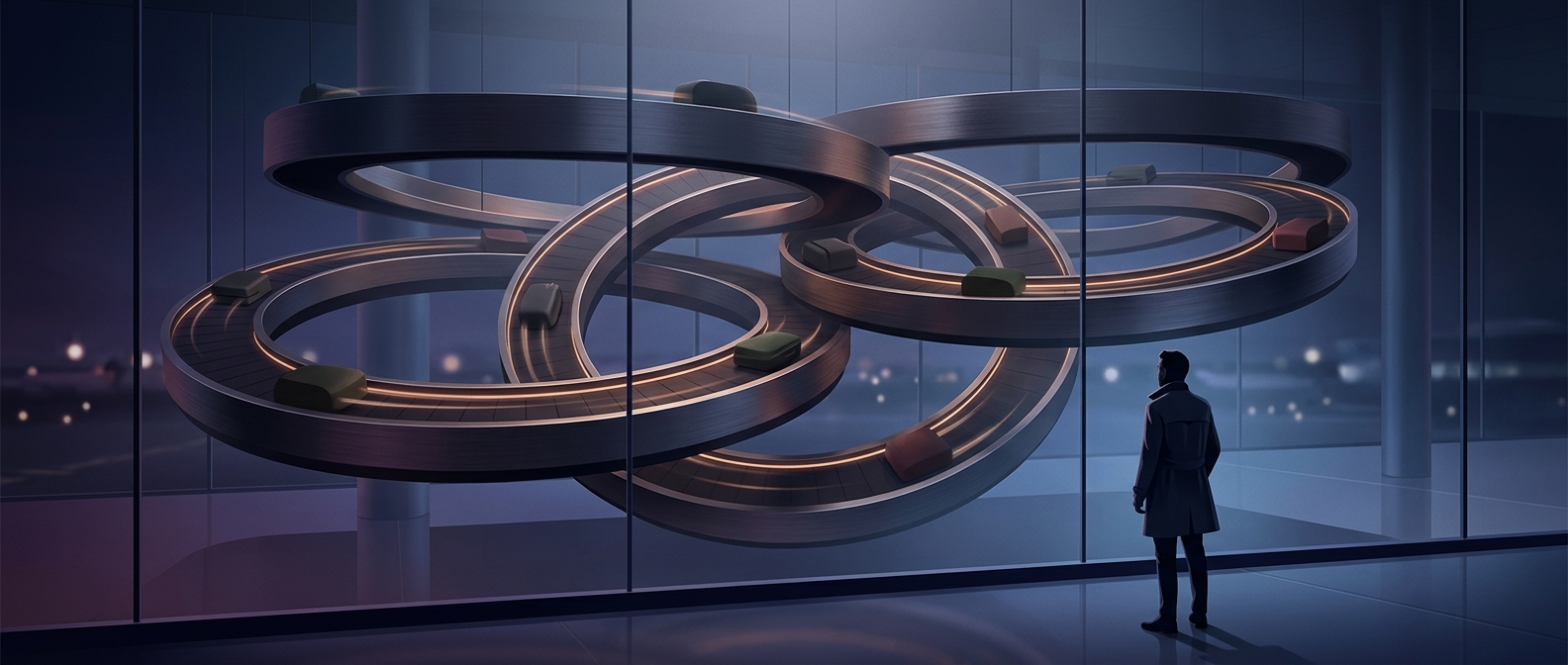
Why the handrail can move you before your feet do
A moving walkway’s floor and handrail are meant to travel in the same direction, but they are separate moving surfaces. The floor is a broad belt beneath your shoes; the handrail is a loop driven by its own mechanism. Their speeds can differ slightly, including as parts wear or the system’s friction changes.
If you stand still on the floor belt and grip a handrail that is moving faster, friction between your hand and the rail carries your hand forward. Your feet, meanwhile, are being carried at the floor belt’s pace. That difference puts a forward pull through your arm and shoulder, which can turn your upper body and shift your balance.
Why a small mismatch matters
The effect is easiest to notice when you are standing upright and holding the rail firmly: your body is not moving as one rigid piece, so the pull can make you lean or take an unexpected step. It is not the walkway suddenly accelerating beneath you; it is the handrail tugging at a different rate from the surface supporting your feet.
This is why the rail is a support, not something to brace against continuously. A light grip lets your arm follow small changes instead of transmitting as much pull to your torso. The practical surprise is that on a walkway, your hand and your feet can be carried forward at slightly different speeds.