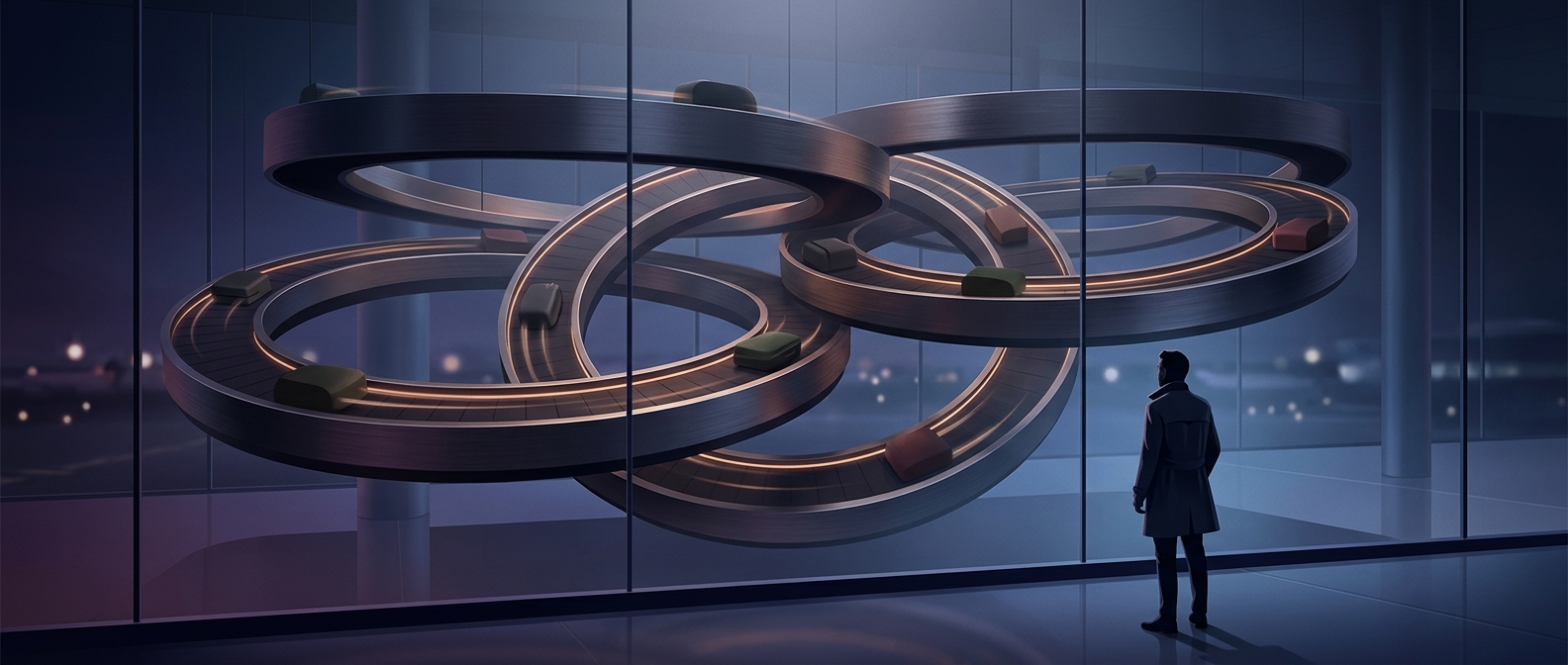
How a Carousel Belt Holds Together Around a Turn
A baggage carousel is not one broad sheet of rubber bending around a corner. Its visible surface is made of many metal plates linked into a moving belt. Each plate can shift slightly relative to its neighbors, letting the belt change direction as it travels around the carousel’s curved ends.
The plates overlap so that this movement does not expose a straight-through opening. As the belt bends, one plate can angle away from the next while still covering the seam. That matters because a suitcase’s edge, wheel, or strap could otherwise catch in a widening gap.
The Loop Keeps the Surface Moving
The belt runs around the carousel in a continuous circuit: bags ride along the upper surface, while the linked plates travel back underneath to begin another pass. At the ends, the belt turns around its supporting structure and returns in the opposite direction. The overlapping joints let that loop bend without breaking the baggage-carrying surface into separate sections.
So the carousel’s apparent smoothness comes not from a single unbroken slab, but from many pieces whose joints are designed to move and remain covered at the same time. That small mechanical compromise—flexibility without an exposed seam—helps bags keep moving through the turns instead of snagging where the belt curves.