How Pedaling Becomes a Wash Cycle
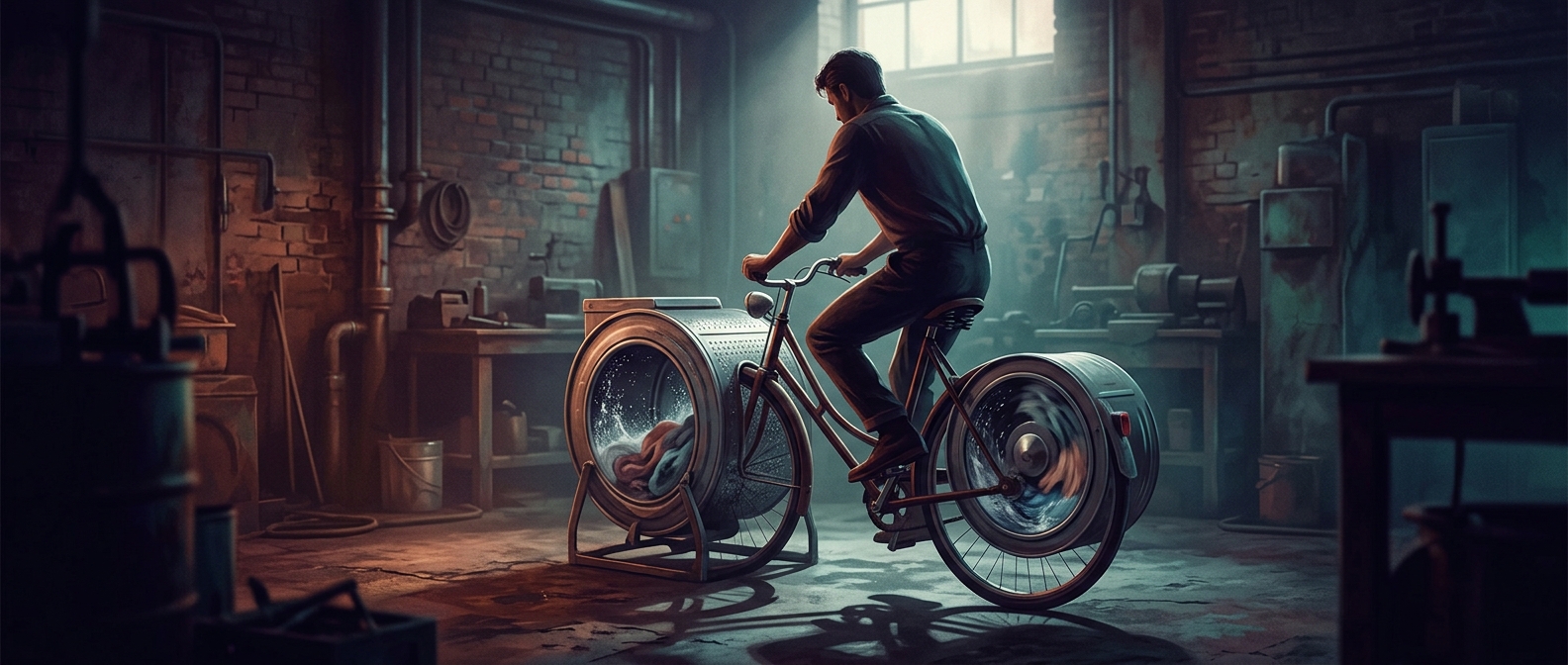
A bicycle crank turns smoothly and continuously, while laundry needs to tumble through water and detergent. A pedal-powered washer links the two with a belt or chain: each turn of the pedals drives the drum, and the clothes lift and fall as it rotates. That repeated movement helps loosen dirt from fabric; the detergent and water carry it away.
The connection can also be geared. A gear ratio trades speed for turning force, so the pedals can drive the drum at a useful pace without requiring the cyclist to spin as fast as the drum itself. The important job is not to reproduce every feature of an electric washer, but to keep a load moving through the wash.
The Human-Powered Tradeoff
Replacing the motor changes the labor, not the basic needs of laundry. Someone still has to add water and detergent, remove the dirty water, rinse the clothes, and get them dry. And because the cyclist supplies the energy directly, a larger or heavier load takes more effort to move than a small one.
That makes this kind of washer most useful where power is unreliable or unavailable and a modest load can be washed by hand-powered motion. It also shifts the machine’s operating cost into human time and effort. The practical test is simple: if the rider stops pedaling, the drum stops too.