The names came after the images
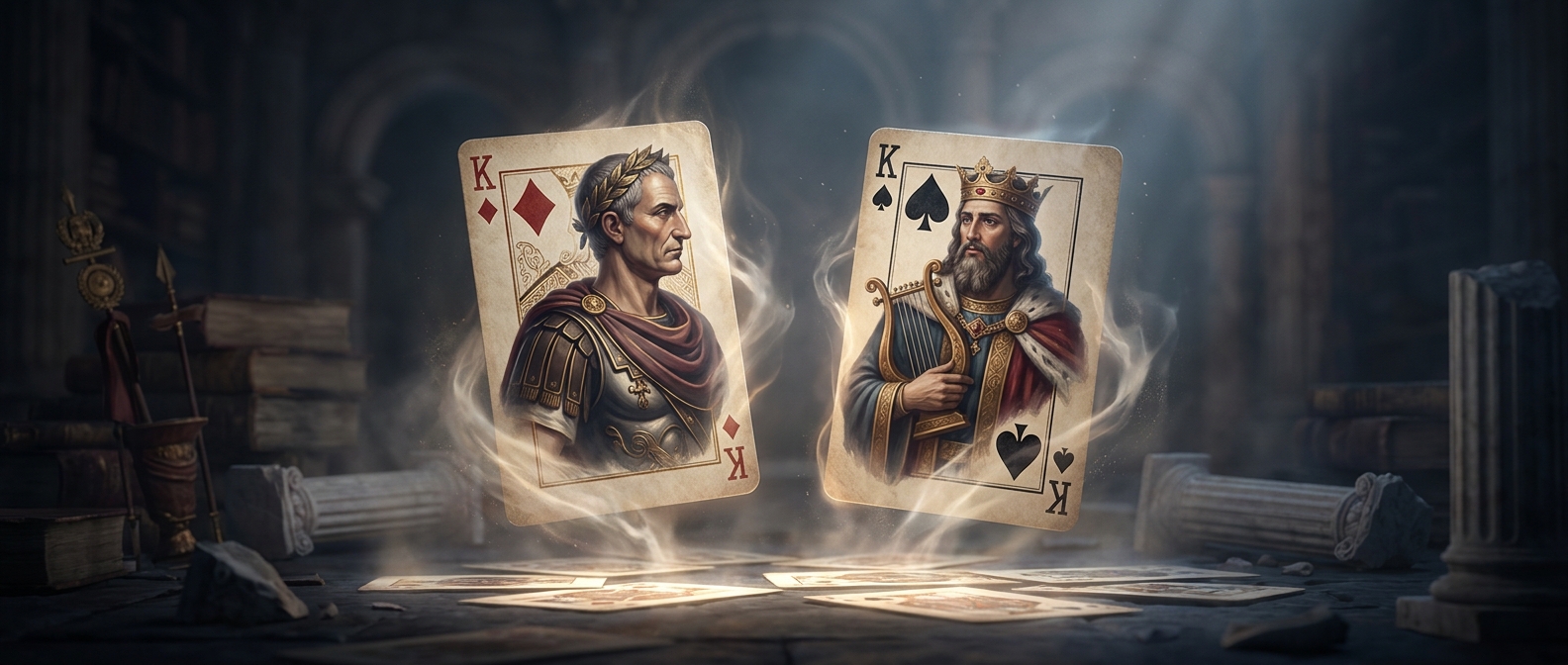
A king on a playing card is not a miniature portrait in the modern sense. The figures belong to a repeatable visual pattern: a crown, a weapon or other courtly object, and a distinctive pose made each rank legible in a small space. As French card designs circulated and were copied, players and writers attached famous names to some of the kings. Those identifications became part of the pattern’s lore.
That distinction matters. The familiar names do not establish that a cardmaker modeled a king on a specific historical portrait, or that every deck used the same identities. The figures are conventional symbols, and their details changed across designs and printings.
A court compressed into a deck
The court cards turn a pack into a tiny social hierarchy: kings, queens, and attendants, repeated across four suits. The historical associations lend that hierarchy extra resonance. Julius Caesar, King David, and Alexander the Great were remembered as powerful rulers, so linking them to kings made the cards feel connected to stories larger than the game itself.
The images also had to work as playing equipment. A card’s figure needed to remain recognizable amid quick dealing and handling, while the same basic design had to be reproduced across many cards. Repeated patterns helped players read rank at a glance; the famous names offered another way to remember which king was which.
Tradition, not a fixed portrait key
The identities are best understood as a naming tradition layered onto a design, not as a reliable guide to who each artist intended to depict. A familiar king can therefore carry two histories at once: the history of the ruler invoked by the name, and the history of the printed image as it was copied and adapted.
That is why a deck can preserve echoes of ancient and biblical rulers without showing what they actually looked like. Its kings are less portraits than portable emblems—small, repeatable pieces of historical imagination built into an everyday game.