How a scooter became a small working vehicle
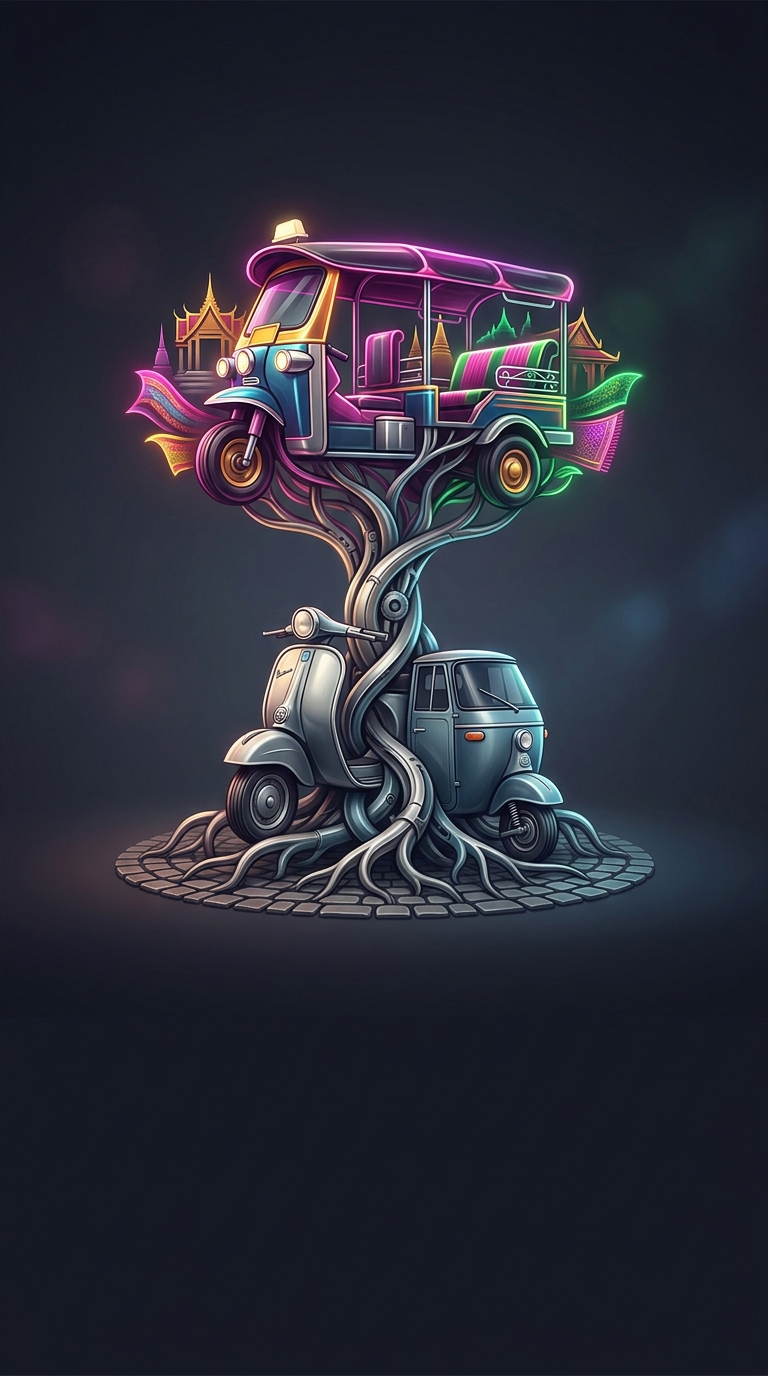
The Piaggio Ape’s cleverness was in keeping much of a scooter and adding only what a delivery job required. Its front wheel, handlebars and familiar scooter controls formed the driving end; behind them sat a compact load space. That layout offered more carrying capacity than a two-wheeler without the size and expense of a conventional van.
The three-wheel arrangement also shaped how it had to be driven. With one wheel at the front and two at the back, the Ape could carry a load across a narrow footprint, but it did not behave like a four-wheeled car. Its small scale made it especially suited to short trips and crowded streets, where maneuverability and access mattered more than speed or cargo volume.
From cargo bed to passenger cab
The Ape was a working design, not yet the familiar passenger rickshaw. The broader family of three-wheelers developed as makers adapted compact scooter-based vehicles to local needs, including carrying people as well as goods. That distinction matters: “tuk-tuk” describes a recognizable kind of vehicle, not necessarily one model or a single, unchanged design lineage.
The Italian connection is therefore a starting point, rather than a claim that every tuk-tuk is simply an Ape. Piaggio’s design showed how a motorcycle-sized front end could be paired with a more useful body. In places where a full-size vehicle was cumbersome, that basic compromise could be reworked into a vehicle for both livelihoods and everyday transport.