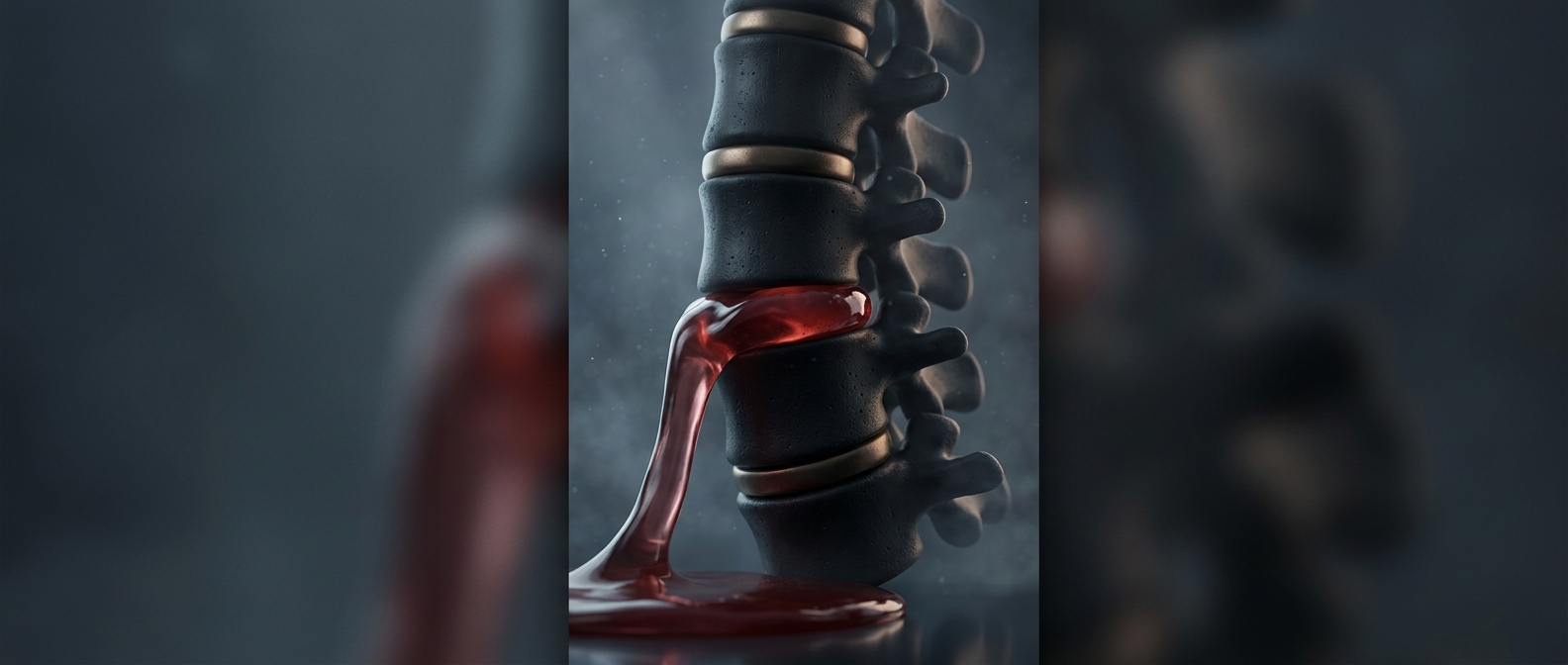
What a spinal disc is made of
Between the bones of the spine, each disc acts as a flexible cushion. Its tough outer layer contains a softer, gel-like center. A “slipped disc” is a common name for damage in which the outer layer weakens or tears and some of the inner material bulges outward. The disc has not necessarily moved as a whole.
Why pain can travel
The bulge itself is not always painful. Symptoms often arise when it irritates or presses on a nearby nerve. Nerves carry signals between the spine and particular areas of the body, so irritation at the back can be felt farther along the nerve’s route—for example, into a leg. This is called radiating pain, and it helps explain why the sore spot may not be where the problem began.
The size of the bulge alone does not determine how much pain someone feels. Its position matters: a small protrusion in a tight space beside a nerve may cause more trouble than a larger one that does not touch one.
What the body does next
Many disc-related symptoms improve over time. The irritated nerve can settle, and the body can gradually break down some of the displaced material. In other words, a disc problem is not automatically a permanently displaced cushion; the symptoms depend on what the damaged tissue is affecting and how that irritation changes.