When Jarry’s public life became a performance
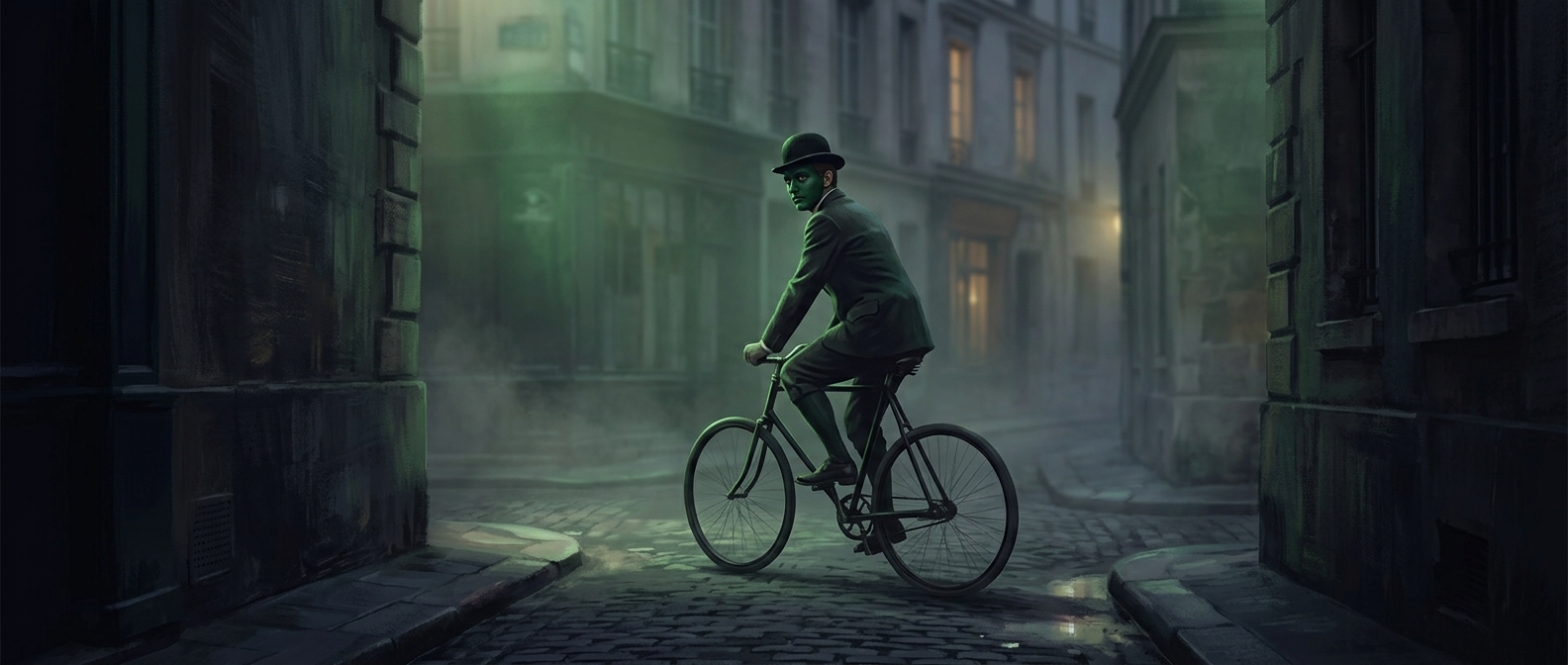
Alfred Jarry was not only a playwright but also a deliberate provocateur, best known for Ubu Roi, a grotesque comedy that made a crude, power-hungry ruler its central figure. His green-painted face and bicycle made an ordinary trip through Paris look less like a discreet commute than a moving piece of theater.
That contrast is what made the image memorable: a bicycle belonged to everyday city life, while a vividly painted face announced that its rider did not intend to blend in. Jarry carried the disruption associated with his writing out of the theater and into the street, where passersby encountered it without needing to buy a ticket or know his plays.
The city as an unwilling audience
A stage gives performers a frame; a Paris street did not. On a bicycle, Jarry could appear suddenly, pass through different neighborhoods, and turn a routine public space into an encounter. The green paint made him unmistakable, while the bicycle kept the spectacle in motion.
The episode is a compact example of how Jarry blurred the boundary between an author’s work and his public persona. His ride was not simply a writer getting from place to place: it made the city itself part of the performance.