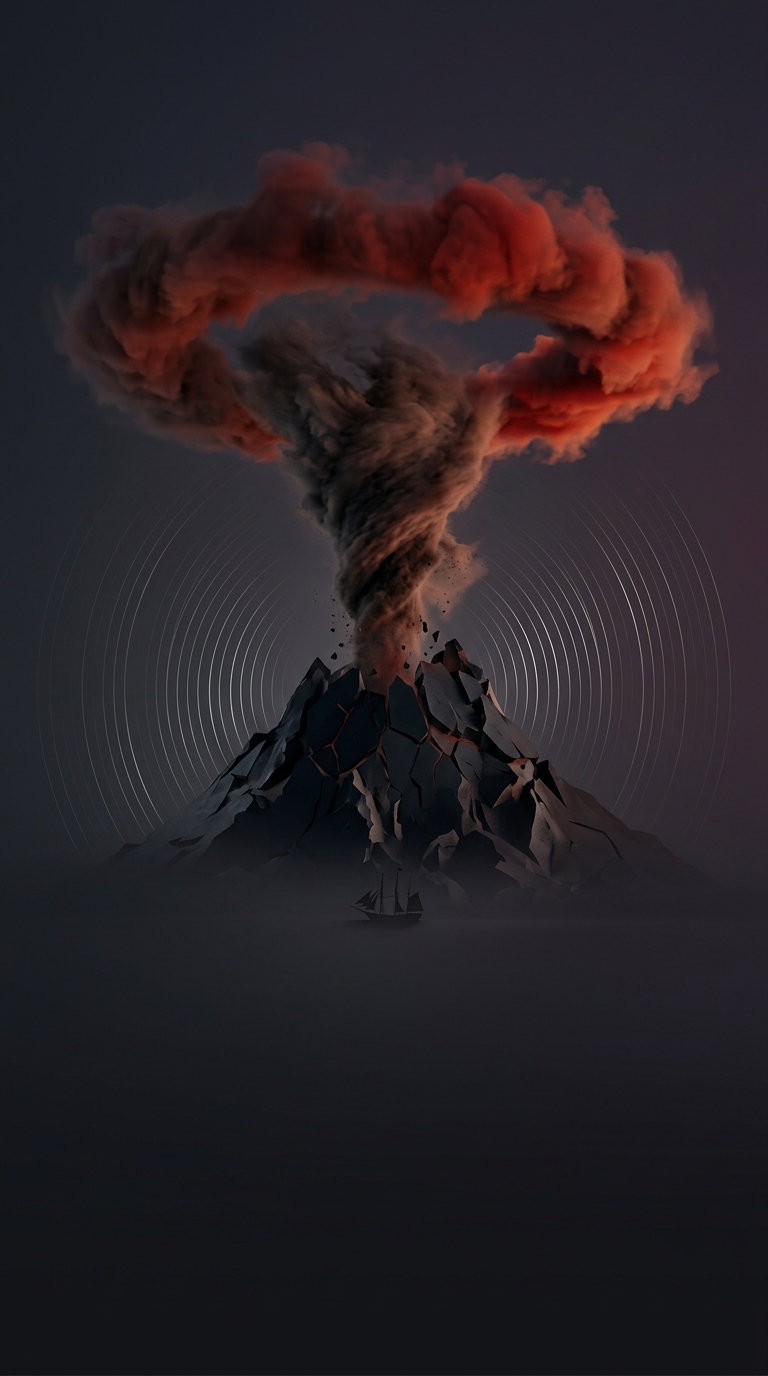
When a sound wave becomes a pressure wave
Krakatoa’s 1883 eruption did more than produce a sound people could hear. The explosion sent a powerful pulse of compressed air racing outward. Close to the volcano, that pulse could injure people through its force; farther away, it arrived as a boom. The distinction matters: the damage was caused by a sudden change in air pressure, not by sound behaving like a solid object.
The atmosphere carried the pulse across extraordinary distances. Instruments called barographs, which continuously trace changes in air pressure, registered the eruption’s wave as it circled the globe. That provided a record of the blast even in places where no one could have mistaken the distant sound for a nearby explosion.
The eruption’s reach was not only auditory
Krakatoa was a volcanic island in the Sunda Strait between Java and Sumatra. In 1883, a sequence of eruptions culminated in the destruction of much of the island. The blast’s pressure wave was one form of its reach; the collapsing volcano also generated tsunamis that devastated nearby coastlines.
These effects help explain why the eruption is remembered as more than an astonishing noise. A sound can fade into a distant report, but the same event can leave a measurable trace in the atmosphere and trigger destructive waves at sea. At Krakatoa, one eruption reached people through air, water, and the ground beneath the volcano.