Why Chicago Pile-1 was built under the stands
In 1942, a group led by physicist Enrico Fermi assembled Chicago Pile-1 beneath the University of Chicago’s football stands. The location was practical: the project needed a large, sheltered space, and the university could provide one. It was also discreet. The work belonged to a wartime effort whose purpose was to investigate whether nuclear fission could yield a sustained source of energy.
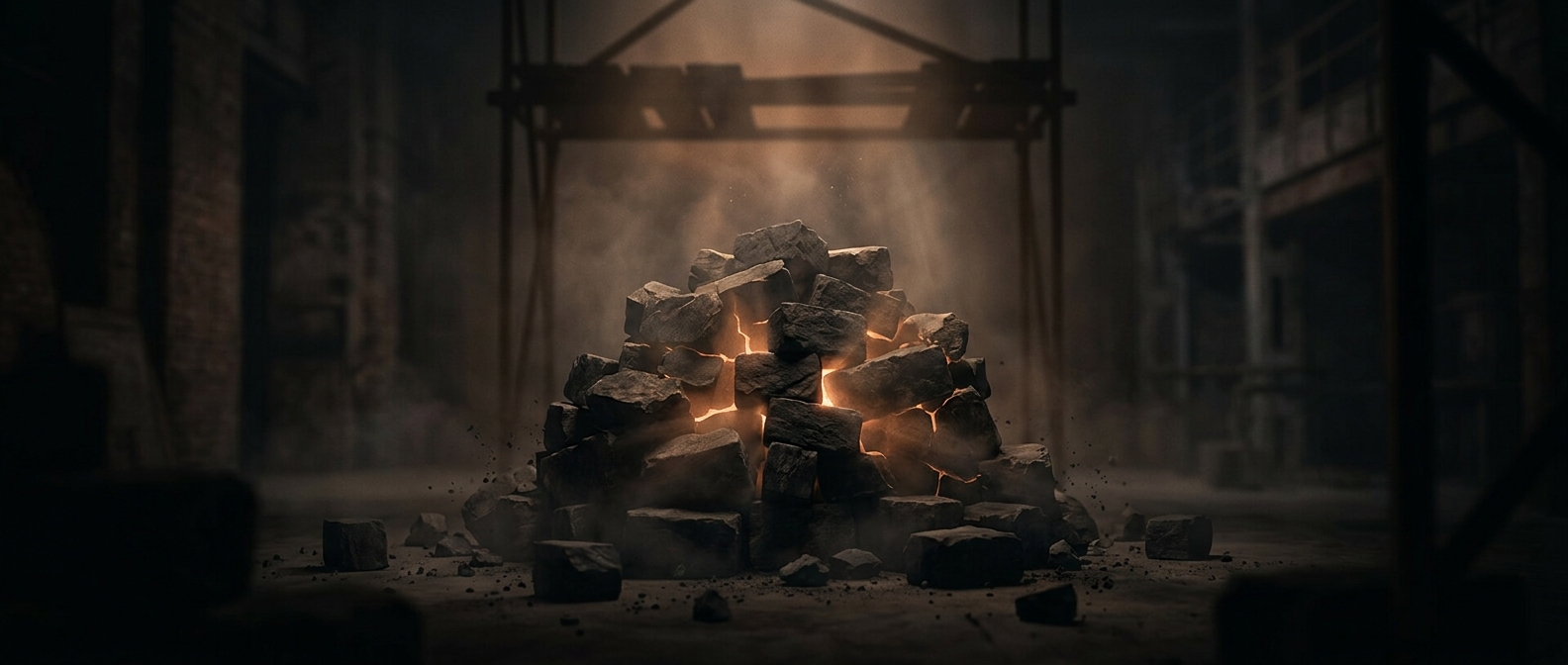
The name “pile” described the apparatus: a massive stack of graphite blocks containing uranium. It was experimental equipment, not a power plant. The challenge was to make the reactions inside the uranium continue in a controlled way rather than die out or accelerate beyond control.
How the pile kept a reaction going
When a uranium atom splits, it releases energy and neutrons. Some of those neutrons can strike other uranium atoms, causing them to split too. But freshly released neutrons often move too fast to trigger fission efficiently. The graphite blocks slowed them, increasing the chance that they would cause further splits.
That creates a chain reaction: each generation of fissions produces neutrons that can start the next. “Self-sustaining” meant the reaction was producing enough effective neutrons to continue without an outside source—not that it was uncontrolled. Control rods made of neutron-absorbing material could be moved into or out of the pile. Pushed in farther, they captured more neutrons and reduced the reaction; withdrawn, they allowed more neutrons to continue the chain.
A controlled reaction, not an electricity supply
On December 2, 1942, the pile achieved the first controlled, self-sustaining nuclear chain reaction. That demonstrated that fission could be managed, a crucial step toward later reactors. Chicago Pile-1 itself did not generate electricity; it was a research experiment, and its successful operation lasted only a limited time.
The contrast is part of the story: a process that would reshape energy and warfare began in a cramped space under a sports venue, with graphite, uranium, and rods that could be shifted by hand to keep the reaction in check.