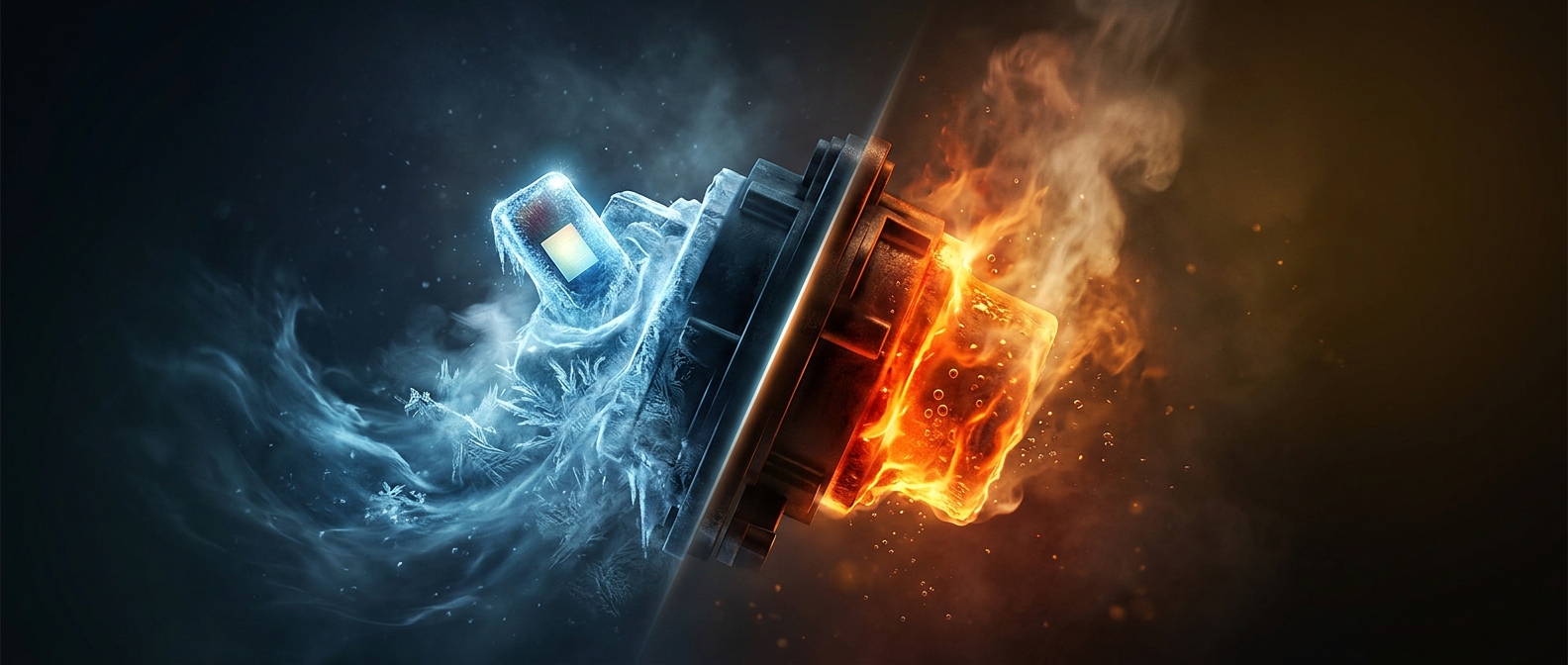
How a current can carry heat
At a junction between two different materials, electric charge carriers do not have exactly the same energy in each material. As they cross the boundary, they absorb heat from one side or release heat on the other. This heat transfer, driven by electric current, is the Peltier effect.
The direction of current matters: reversing it reverses which junction absorbs heat and which releases it. The effect is easiest to use with semiconductors, whose properties can be engineered for efficient heat transfer. A practical thermoelectric module links many small semiconductor pairs electrically in sequence and places them side by side between two plates.
Cooling depends on the hot side
The cold plate can draw heat from an object, but that heat has to go somewhere. It is carried to the module’s hot plate, which must shed it to the surrounding air or another cooling system. If the hot side cannot lose heat fast enough, it warms the cold side too.
There is another limit: current flowing through the materials also produces ordinary electrical heating. Designers balance that unwanted heat against the heat being pumped. This is why a thermoelectric cooler is useful for precise, compact cooling, but may be less efficient than a compressor system when it must move a large amount of heat.
Where the tradeoff is useful
Because the module has no mechanical pumping cycle, it can be small and precisely controlled. It is used in applications such as stabilizing the temperature of sensitive electronic or optical components. Reversing the current can also make the same module heat instead of cool—provided its hot side can still manage the heat it releases.