Geometry as a system of consequences
Euclid’s Elements is organized less like a catalog of shapes than like a route through a landscape. It begins with definitions and basic assumptions, then derives claims about lines, angles, and figures through carefully ordered arguments. A proof must make clear not only that a result is true, but why it follows from what has already been established.
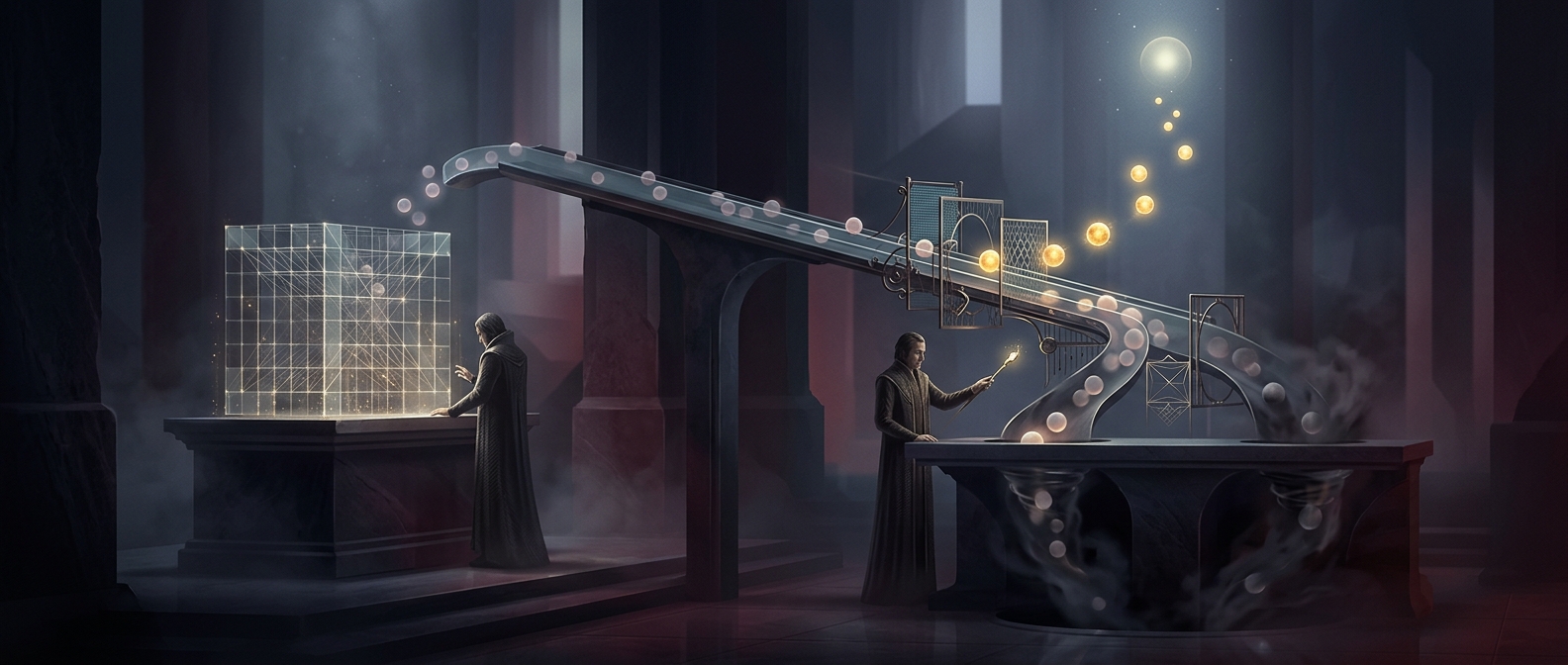
That structure changes how a reader can use a theorem. Once a claim has been proved, later arguments may rely on it instead of starting over. The book’s propositions therefore form a network: a result about triangles, for example, can become a step in proving something about more complicated figures. If a link in the reasoning is weak, the trouble can be traced back through the chain.
Why the method outlasted the diagrams
Euclid did not invent every result in the book. Its enduring achievement was to arrange mathematical knowledge into a system whose conclusions could be checked against explicit starting points. That approach—state assumptions, define terms, and show each inference—became a model for presenting mathematics well beyond geometry.
The geometry itself also has a boundary: Euclid’s framework describes a flat plane, including its familiar rule for parallel lines. Mathematicians later explored geometries built from different assumptions, such as curved spaces. Those alternatives did not erase Euclidean geometry; they showed more clearly what its starting assumptions determine.
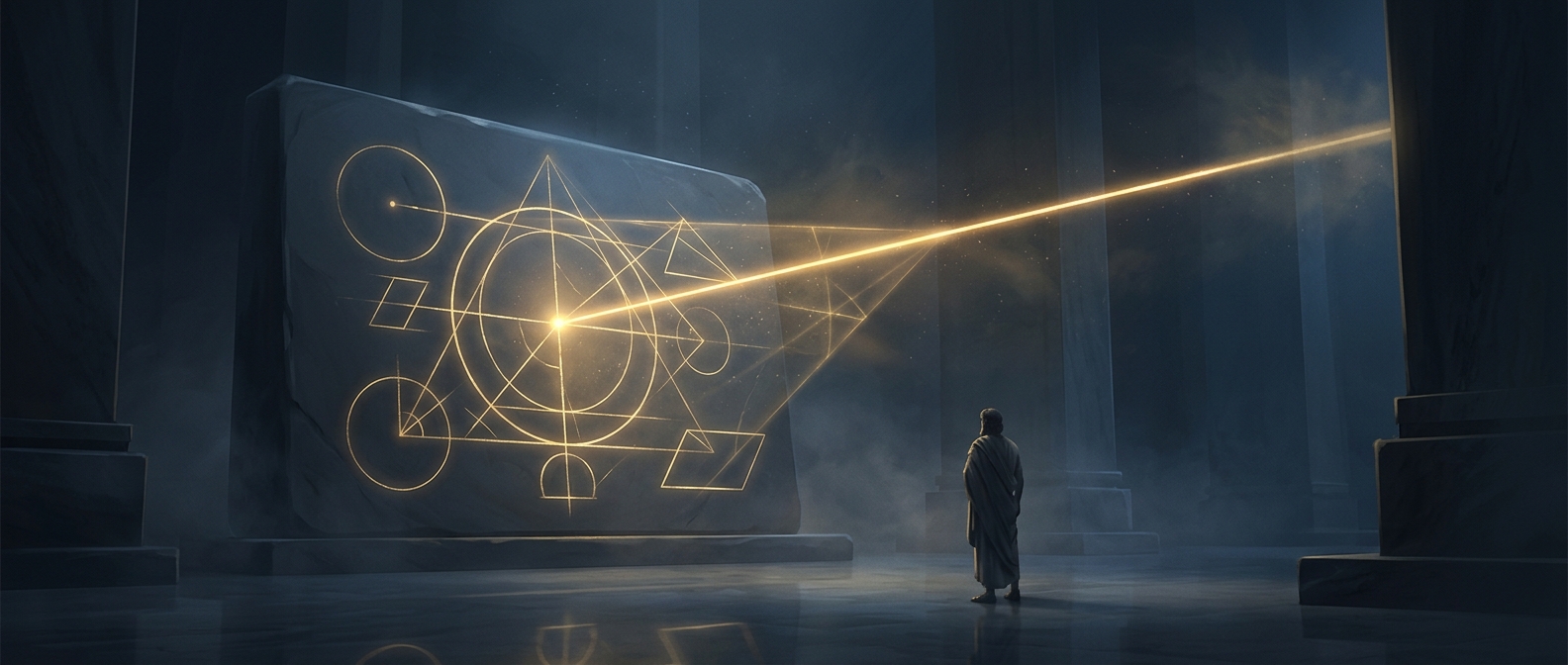
In a classroom, the lasting lesson is practical: a diagram may suggest an answer, but only a chain of reasons establishes it. That distinction is what lets one proved result support the next.