The proof replaced an endless map search with a finite one
The four-color theorem says that any map drawn on a flat surface can be colored with at most four colors so that regions sharing a boundary get different colors. The challenge is that maps come in endlessly many shapes and sizes. Checking a few examples cannot establish the rule for every possible map.
The breakthrough was to show that any hypothetical counterexample would have to contain at least one pattern from a carefully chosen finite collection. The proof then showed that each such pattern could be simplified: if it appeared in a smallest counterexample, the surrounding map could be recolored to produce a smaller one. That contradiction rules out counterexamples altogether.
The computer checked the cases too numerous to handle by hand
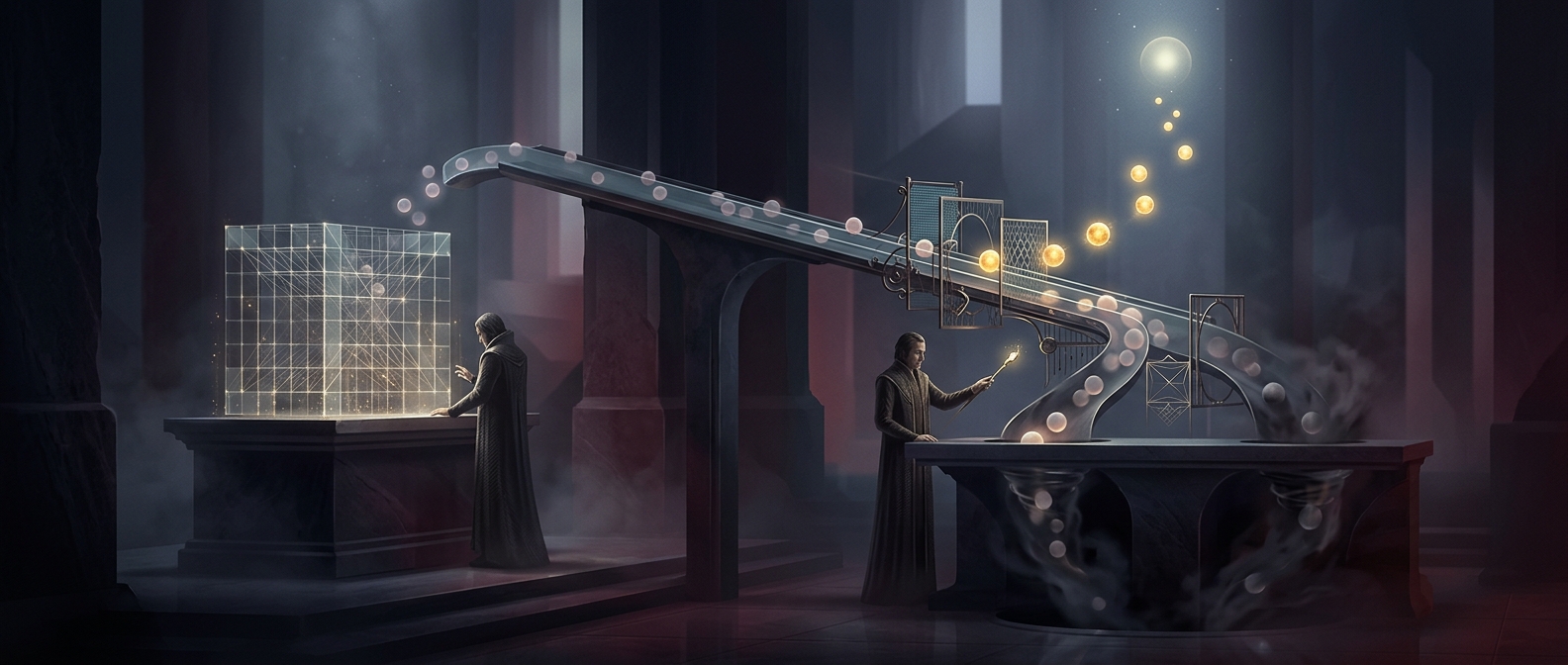
The hard part was establishing that the collection of patterns really covered every possibility and verifying the many individual simplifications. In the 1970s proof, a computer performed much of that checking. It did not guess colors for every map; it checked a finite, technically specified set of cases within a larger mathematical argument.
That distinction mattered. A conventional proof lets readers follow each inference on paper. Here, the conclusion depended partly on a program’s calculations, and reproducing or inspecting all of them by hand was impractical. The machine’s output was therefore not just a convenience: it became part of the evidence for the theorem.
What counts as a proof when a machine helps?
The dispute exposed a question about mathematical trust. A computer can make mistakes, and a long calculation can be difficult to audit even if its method is sound. The theorem’s acceptance depended on checking the reasoning and the computation well enough to treat the result as reliable—not on treating the computer as infallible.
The lasting consequence was a broader idea of proof: some arguments can be mathematically rigorous even when no person can conveniently verify every low-level step unaided. In this case, the computer did not replace the mathematicians’ reasoning; it carried out the exhaustive checking that made their argument workable.