A railway built around the mailbag
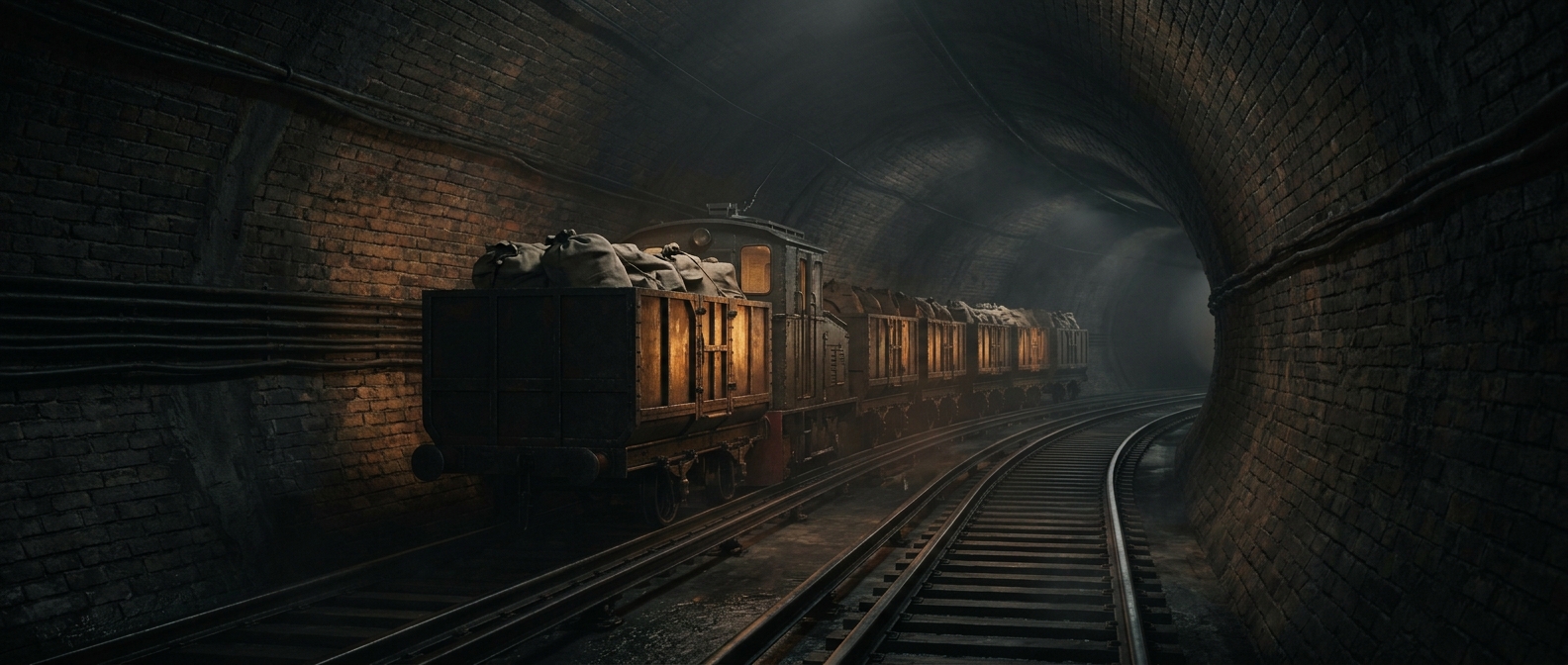
London’s Post Office Railway was designed to solve a logistics problem: letters had to travel between major sorting offices quickly, but surface deliveries competed with ordinary traffic. The answer was a separate underground route, sized not for passengers but for compact electric trains carrying mail.
The railway opened in 1927. Its tunnels linked sorting offices across central London, allowing post to move between them without being loaded onto street vehicles for each leg. At each stop, workers transferred mailbags between trains and the sorting operation above. The underground line acted like a conveyor belt connecting separate stages of a much larger system.
Why the small trains mattered
A passenger railway needs room for people, platforms and access. Mail Rail’s trains needed space mainly for bags, so its tunnels and vehicles could be much narrower. That compact scale made it possible to run a dedicated route beneath a dense city, where a full-sized railway would have been far more difficult to fit.
Electric power also suited the enclosed tunnels: trains could make repeated trips without producing exhaust inside them. The system’s value came from coordination as much as speed. If mail was sorted and ready at one office, a train could carry it directly to another, where it could be sorted again or sent onward.
When the network stopped paying its way
The railway ran for decades, but changes in mail volumes and the cost of maintaining a specialized underground system weakened its case. It closed in 2003. Its story shows how transport infrastructure can be tailored to a particular kind of cargo—and how a network built to remove one bottleneck can become expensive when the flow it serves changes.
For years, London’s letters could make part of their journey beneath the same streets where delivery traffic crawled above.