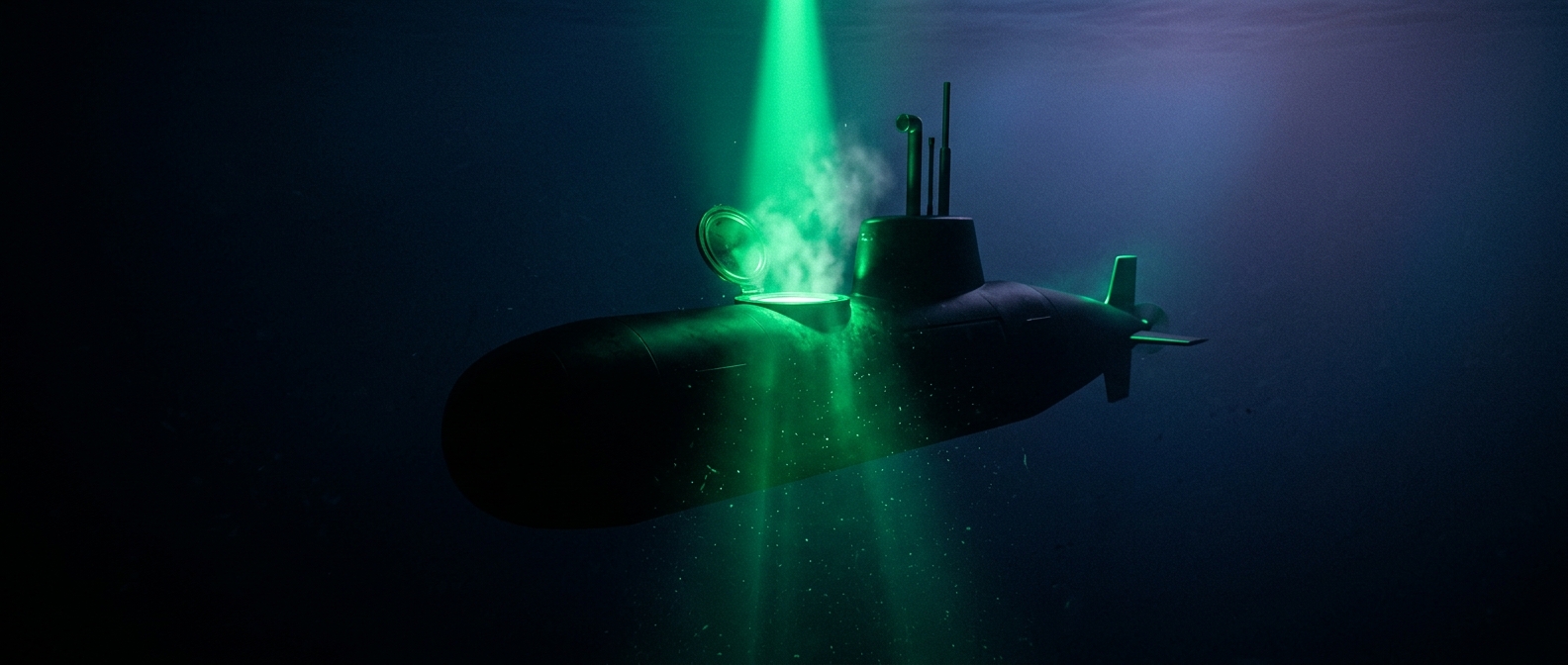
Why dark paint can hide a submarine better than ocean blue
A submarine is not usually trying to match the water’s color as seen from the shore. It is trying to avoid forming a conspicuous shape against whatever background an observer—or a camera—can see. Near the surface, that background may be bright sky reflected from the water; deeper down, it may be dim water with little color left in the available light. A blue hull can contrast sharply with either one.
Dark paint helps reduce that contrast, especially in low light. Water absorbs and scatters light as it travels, so the familiar blue of a sunlit sea does not stay equally vivid at depth. In dim conditions, a dark submarine is less likely to appear as a bright, colored patch against the surrounding water.
The finish matters, too
A glossy surface can reflect sunlight or other illumination, creating a flash that gives away a vessel’s outline. A low-sheen finish limits those reflections. The goal is not to make a submarine invisible, but to make it harder to pick out at a glance and harder to track visually when conditions are favorable to an observer.
Paint is only one part of concealment. Submarines also rely on depth, darkness, and careful movement; specialized surface treatments can address other detection problems, such as sound. Black is a practical visual compromise, not a magic color that disappears in every sea. Water clarity, lighting, and viewing angle all affect how well it works—which is why the ocean’s changing appearance is a poor guide to the best color for a submarine.