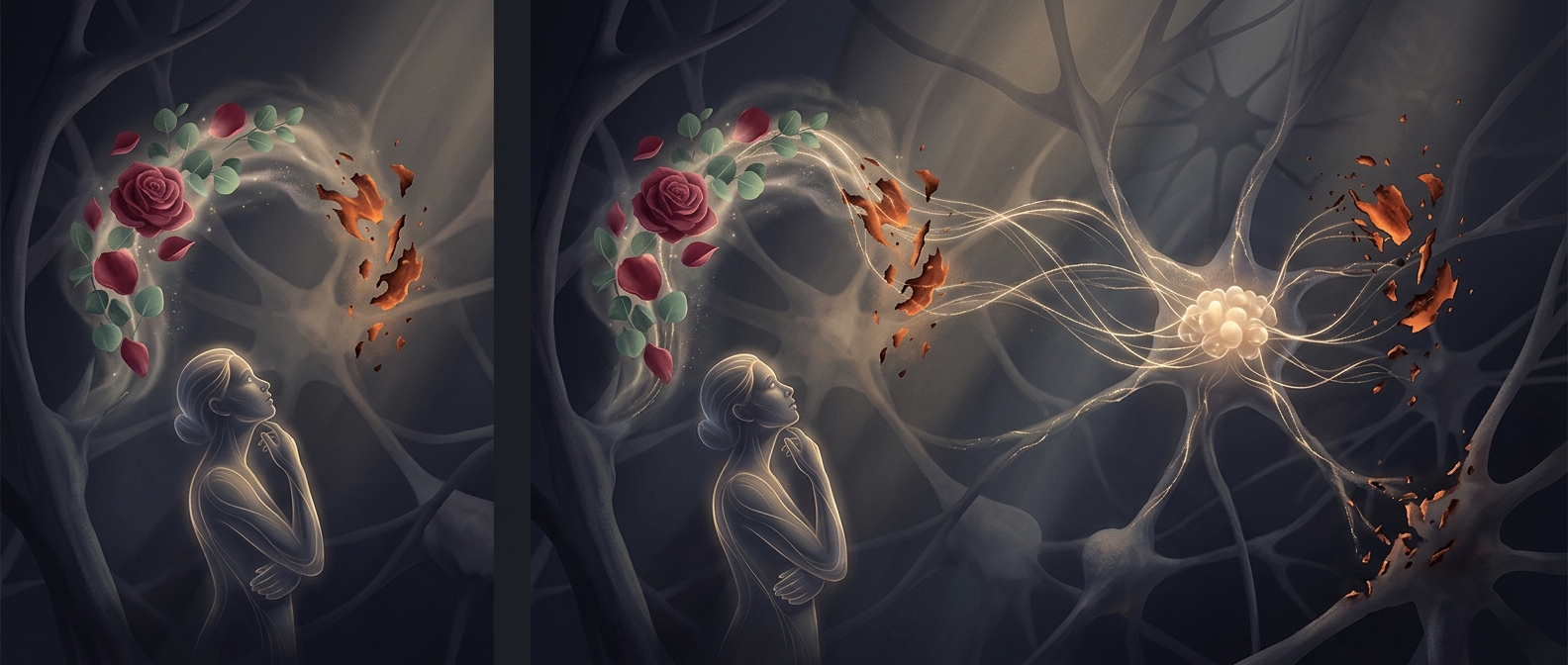
How a slow-moving brain wave can alter vision
Many migraine auras begin with a small shimmering patch or zigzag that gradually expands across a person’s field of view. The pattern can look as if it is moving, even though it arises from changes in brain activity rather than from anything happening in the eyes.
One leading explanation is cortical spreading depression: a wave of intense activity followed by a temporary reduction in activity that travels through the brain’s outer layer. In a visual aura, the wave is thought to pass through the occipital cortex, the region at the back of the brain that processes sight. As it moves across neighboring areas, the visual disturbance can shift or widen over several minutes.
Why the pattern can look jagged
The visual cortex is organized like a map: nearby parts of the cortex process information from nearby parts of the visual field. A wave moving across that map can therefore produce a disturbance that seems to travel across what a person sees. The bright, angular edges are thought to reflect the way changing activity affects visual processing; the exact details vary from one person and aura to another.
“Spreading depression” does not mean the brain shuts down. It describes a short-lived change in the activity of a patch of cortex. The process is difficult to observe directly during a human migraine, so researchers treat it as a leading mechanism rather than a complete explanation of every aura.
Aura and headache do not follow a single script
Visual aura often comes before migraine pain, but it can overlap with the headache or occur without one. The timing is not a dependable countdown: the brain wave helps explain how an aura may unfold, not precisely when pain will begin.
Lewis Carroll’s descriptions of distorted sizes and shapes have often been compared with migraine aura. That resemblance is suggestive, but it does not establish that migraine caused his experiences or inspired Alice’s Adventures in Wonderland. The more immediate implication is that an aura’s dramatic visual effects can arise from a slow, shifting change in the brain’s own visual circuitry.