How a Few Rules Make an NPC Seem Clever
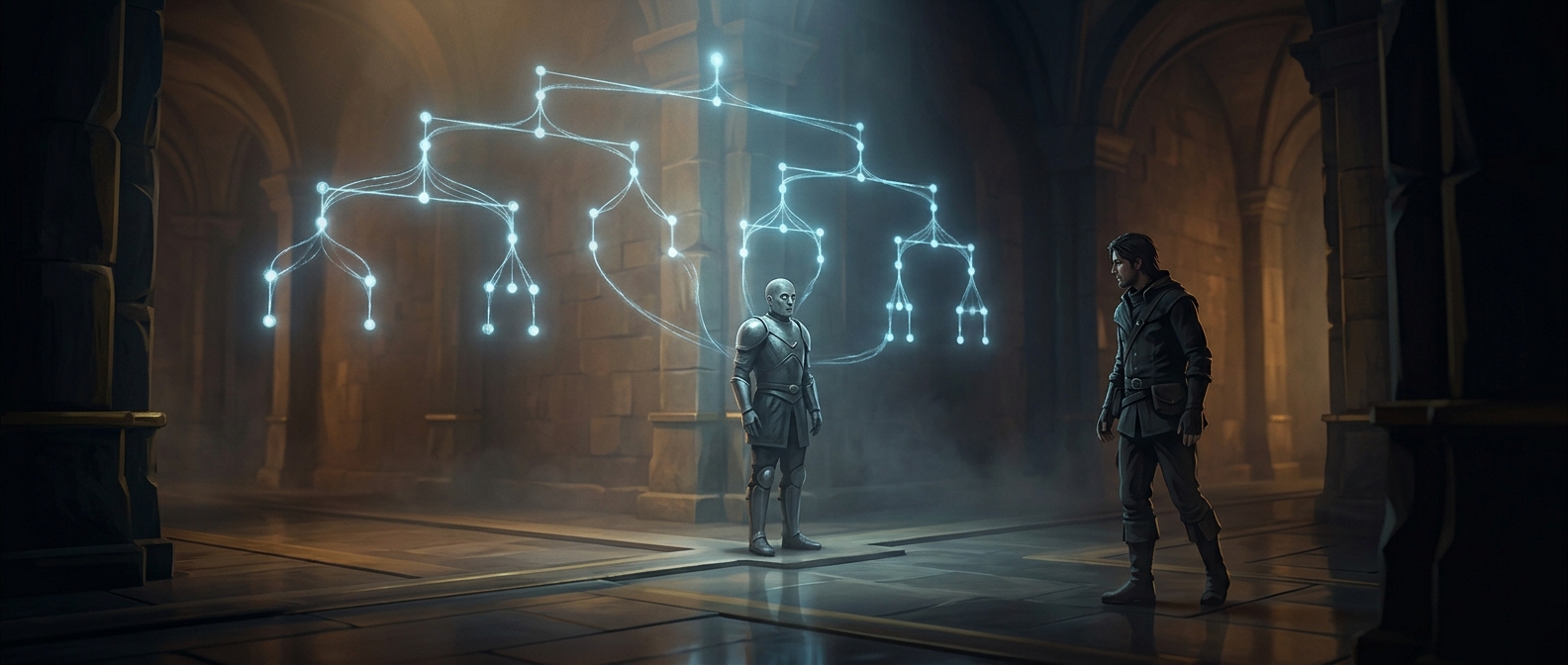
A behavior tree organizes an NPC’s choices into a hierarchy. At the top are broad priorities; below them are smaller checks and actions. The game repeatedly evaluates the tree, often many times per second, so the character can respond as the situation changes rather than follow one fixed sequence from beginning to end.
A guard might first check whether it has been attacked. If so, it may pursue or fight. Otherwise, it may check whether the player is nearby; if not, it returns to a patrol. Each check produces a simple outcome—such as “true,” “false,” “running,” or “finished”—that tells the tree whether to continue, stop, or try another branch. The result is not a mind weighing every possibility. It is a structured set of priorities.
Why the Rules Can Look Like Intelligence
The impression comes from timing and context. An NPC that turns toward the player, closes the distance, and attacks only when close enough appears to make a plan. In practice, those actions can be separate rules connected by conditions: detect the player, move within weapon range, then attack when the weapon is ready. If the player retreats, the tree can switch back to movement instead of blindly repeating the swing.
That structure also gives designers control. They can make an enemy cautious by adding a retreat condition, or more aggressive by giving combat higher priority than patrol. Small changes in thresholds and priorities can produce noticeably different behavior without requiring a completely new system.
The tradeoff is that an NPC can only react to situations its rules anticipate. When its responses seem oddly repetitive, the apparent mind has reached the edge of its decision tree.