How a Slinky can hang in midair
Stretch a Slinky vertically and hold both ends. When you release the top, the coils there begin to fall, but the bottom may remain nearly still for a moment. The reason is that the change caused by the release has not yet traveled the length of the spring.
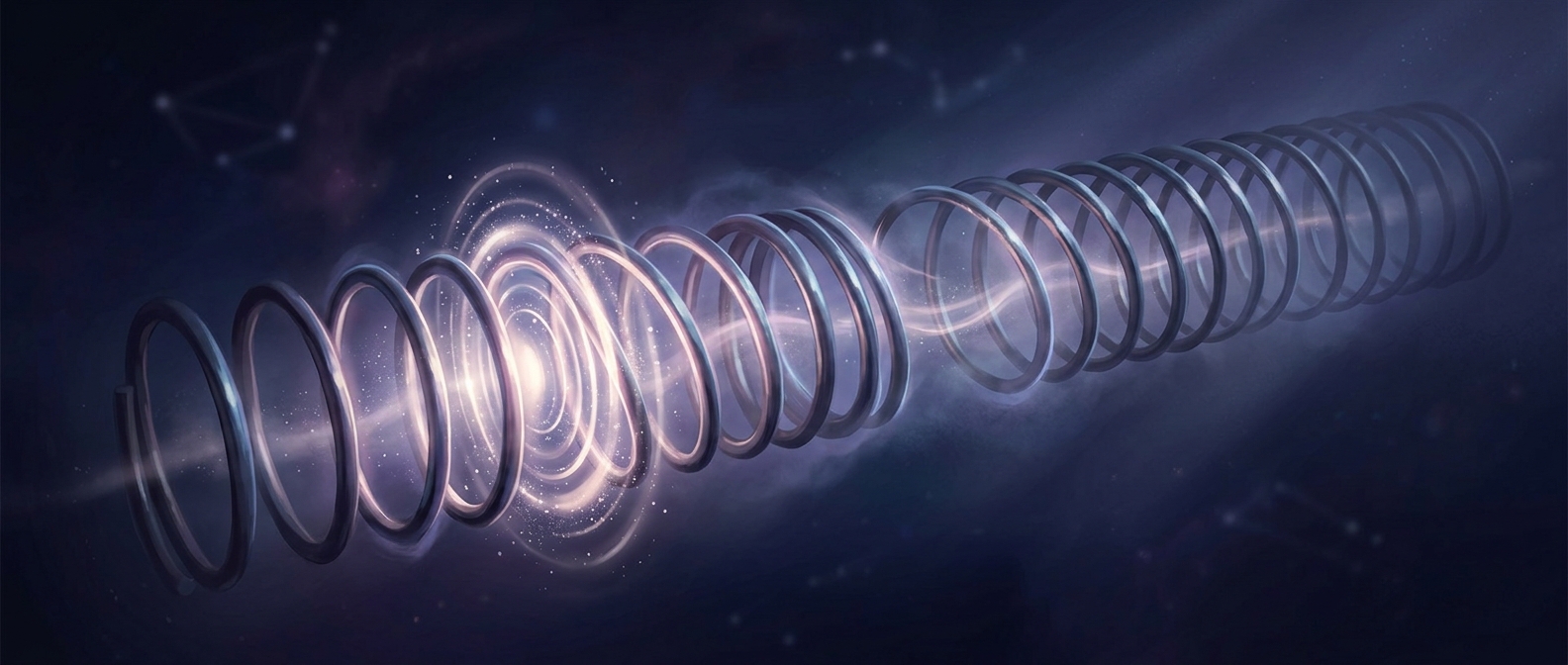
A Slinky is made of connected coils, so one part can respond before the rest. As the top drops, nearby coils shift and the spring’s tension changes. That change passes from coil to coil as a longitudinal wave: the coils move along the spring’s length, carrying the disturbance downward.
Gravity acts locally; information takes time
Before release, tension in the stretched coils helps support the Slinky’s weight. Once the top is let go, the upper coils start collapsing and no longer pull on the coils below in quite the same way. But the lower coils cannot respond until that altered tension reaches them. Until then, they remain supported by the tension they were already experiencing.
This is not gravity switching off below the wave. Gravity pulls on every coil throughout the fall. The apparent pause happens because the forces on the lower section have not yet changed: it has not received the mechanical signal that the top is free.
The pause ends when the wave arrives
When the disturbance reaches the bottom, those coils begin to move too, and the spring collapses. The effect is brief, and its timing depends on how quickly a tension change travels through that particular Slinky. The memorable image—a falling top above a suspended bottom—is a visible demonstration that mechanical forces do not adjust everywhere at once.