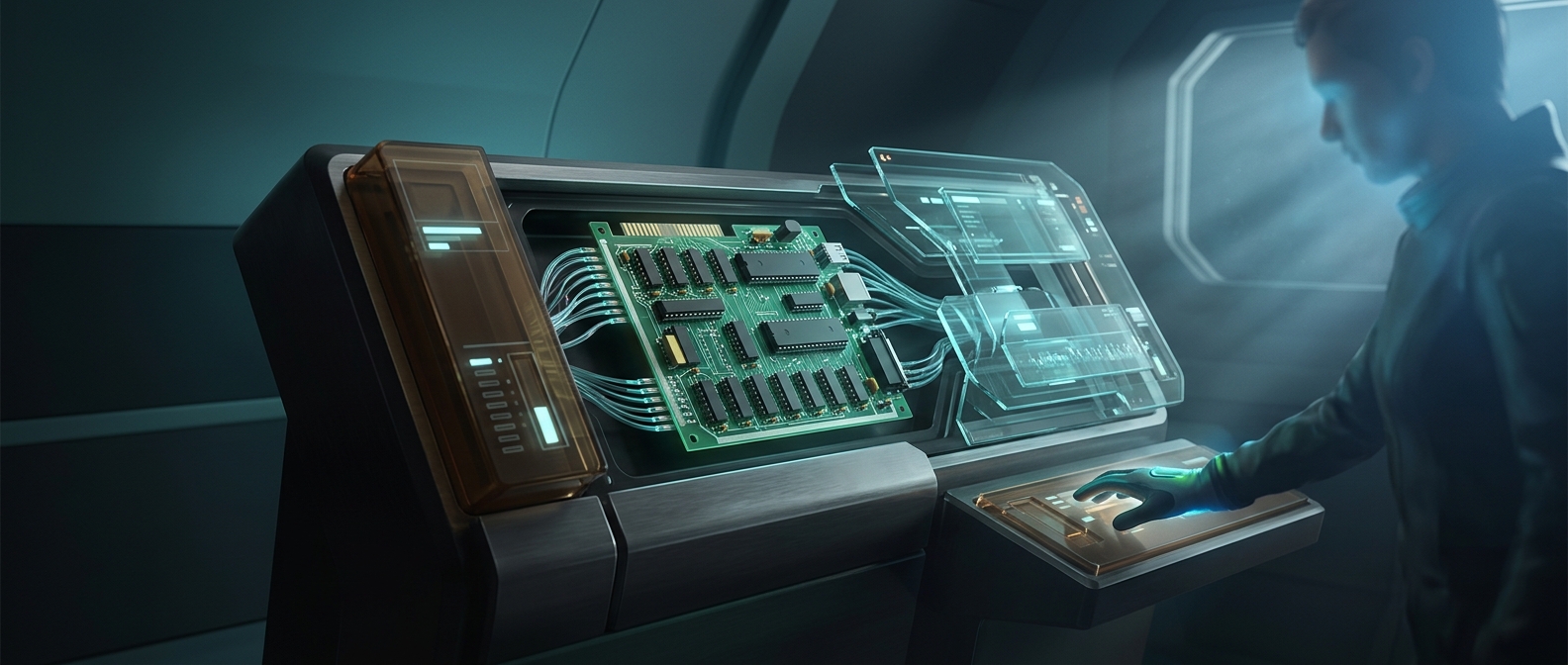
A real microcomputer on the wall
The Acorn System 1 was not a purpose-built science-fiction prop. It was an early British microcomputer sold as an electronics kit: a compact circuit board that users could assemble and experiment with. Its components were left visible, rather than hidden inside a finished case, giving it the exposed-wires-and-lights look that made it convincing on a spaceship set.
The board was a working computer, but its job was far more modest than controlling a spacecraft. A small keypad let a user enter instructions, while LED displays showed hexadecimal numbers—a compact way of representing the values computers handle internally. That arrangement was useful for learning and testing, not for commanding a fictional starship.
Why the design looked futuristic
In the late 1970s, a panel crowded with visible circuitry and glowing indicators could read as advanced technology without needing elaborate fabrication. The System 1 supplied real components and real displays in one ready-made object. Mounted on a set wall, it could suggest a control system while avoiding the need to build every detail from scratch.
That contrast is the fun of the prop: the audience saw a spaceship computer, but the hardware began as a hands-on microcomputer kit. Its LEDs were not just painted decoration; they were part of a small machine built to make computer activity visible. Bulky, exposed electronics that were practical for a hobbyist became the visual language of the future on television.