Why the doorway becomes a timing problem
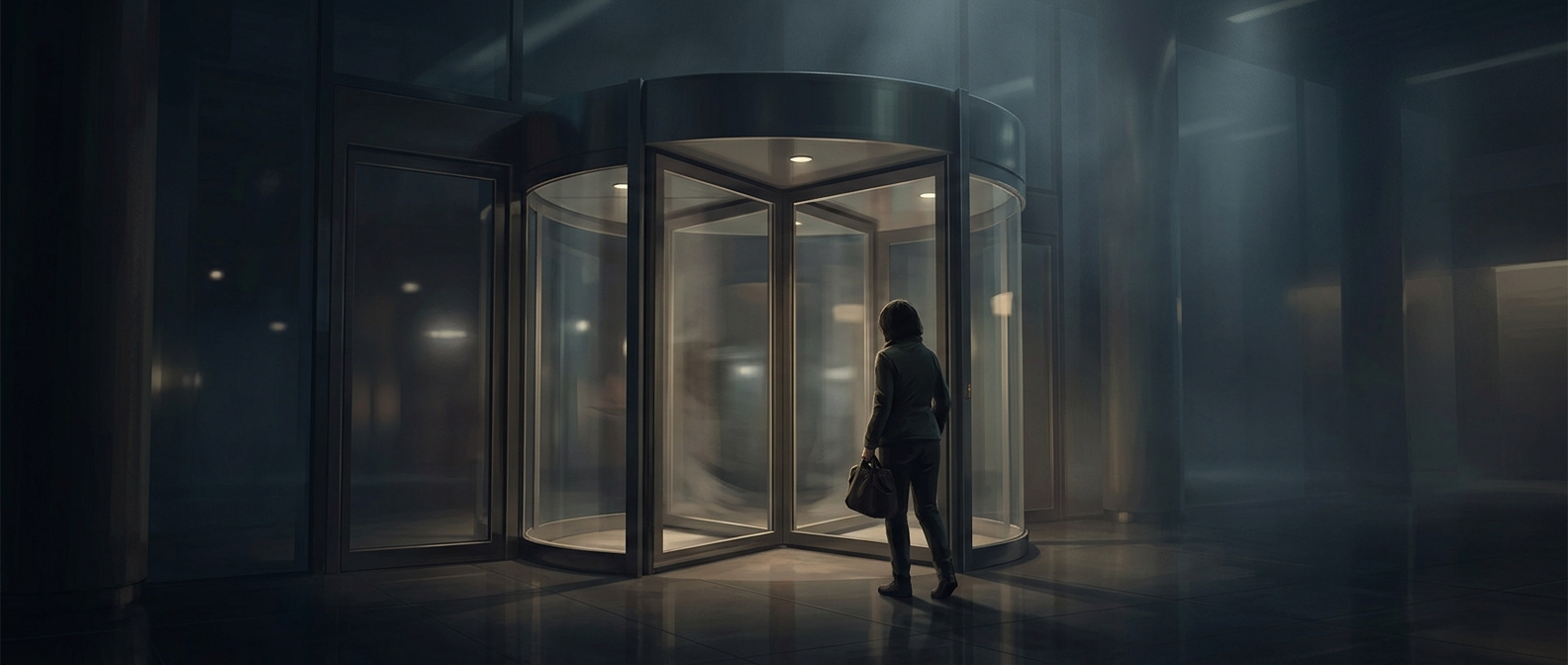
A revolving door turns an ordinary step across a threshold into a small coordination task. You have to choose an open compartment, judge how quickly it is moving, and step in without letting the next panel catch your heels. Unlike a hinged door, it does not wait for you to push it open and then stay put.
The panels rotate around a central shaft, dividing the entrance into compartments that travel along a circular path. Once you enter one, the panel behind you keeps the space enclosed while the door carries you toward the other side. That gives you a moving boundary to track, not just a doorway to cross.
Why people slow down
The safest-feeling moment to enter is when a compartment appears to offer enough room. But estimating that room while the panel is moving takes a beat: step too early and you may feel crowded; wait too long and the opening has moved on. People also tend to match their pace to the door rather than stride through at their usual speed.
That pause can become more noticeable when someone is approaching from the opposite side. Each person must occupy a separate compartment, so both may hesitate to avoid entering the same space or forcing the other to adjust. The door’s steady rotation makes the decision feel like a countdown, even though the actual task is simply to step in, walk with the panels, and exit at the next opening.
A tradeoff built into the entrance
Revolving doors are designed to keep an entrance usable while limiting the direct exchange of indoor and outdoor air: as one compartment moves out, another moves in, rather than leaving a single wide opening exposed. The compartments and panels create that separation, but they also make the entrance less intuitive than a clear, stationary doorway.
So the hesitation is not just indecision. It is the brief adjustment required when a familiar action—walking inside—has to be timed to a moving machine.