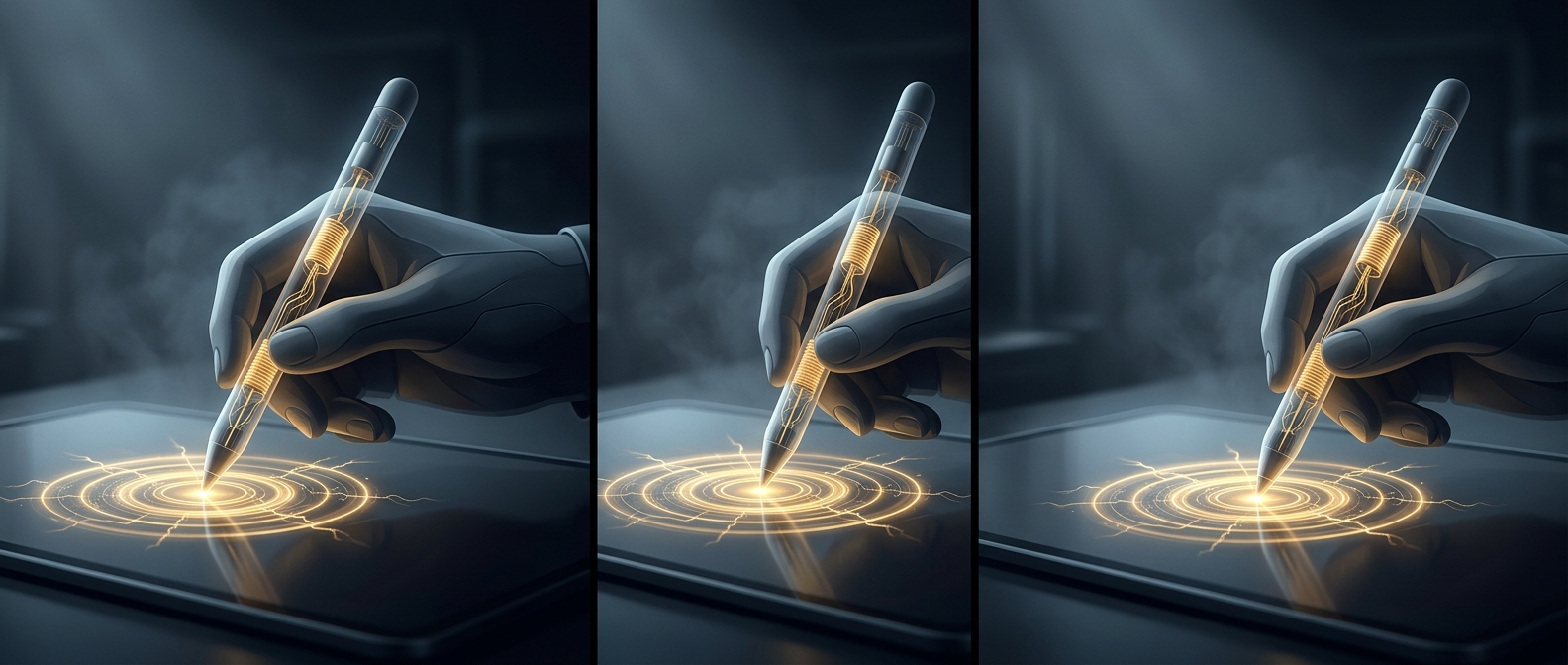
How a battery-free stylus gets its power
A battery-free stylus works only with a screen built to communicate with it. Beneath the glass, a digitizer—a layer of sensing components—creates a changing electromagnetic field. A small coil inside the pen picks up energy from that field, much like a transformer transfers energy between nearby coils. The pen can use that harvested energy to produce a response the tablet can detect.
The tablet’s field is weak and reaches only a short distance, so the stylus does not need to store power for later. It is energized while it is near the screen. This is a form of inductive coupling: energy crosses a small gap through a magnetic field rather than through a wire or a battery.
The pen’s reply carries more than location
The tablet also needs to distinguish the pen’s signal from the background and determine where it is. By sensing the reply across components in the digitizer, it can estimate the stylus’s position. In compatible systems, the pen can also alter its electrical response when its tip is pressed. The tablet interprets that change as pressure, allowing a drawing app to vary a stroke’s width or darkness.
Because the screen supplies the operating energy, a passive stylus avoids battery charging and the added weight or bulk of a power source. The tradeoff is compatibility: a plain passive pen cannot communicate with just any touchscreen. The tablet must contain the matching sensing hardware, and the pen must be designed for that system. A battery-free pen is therefore not simply an ordinary stylus with its battery removed; it is part of a power-and-signal system built into the screen.