How soft, even light makes a set easier to shoot
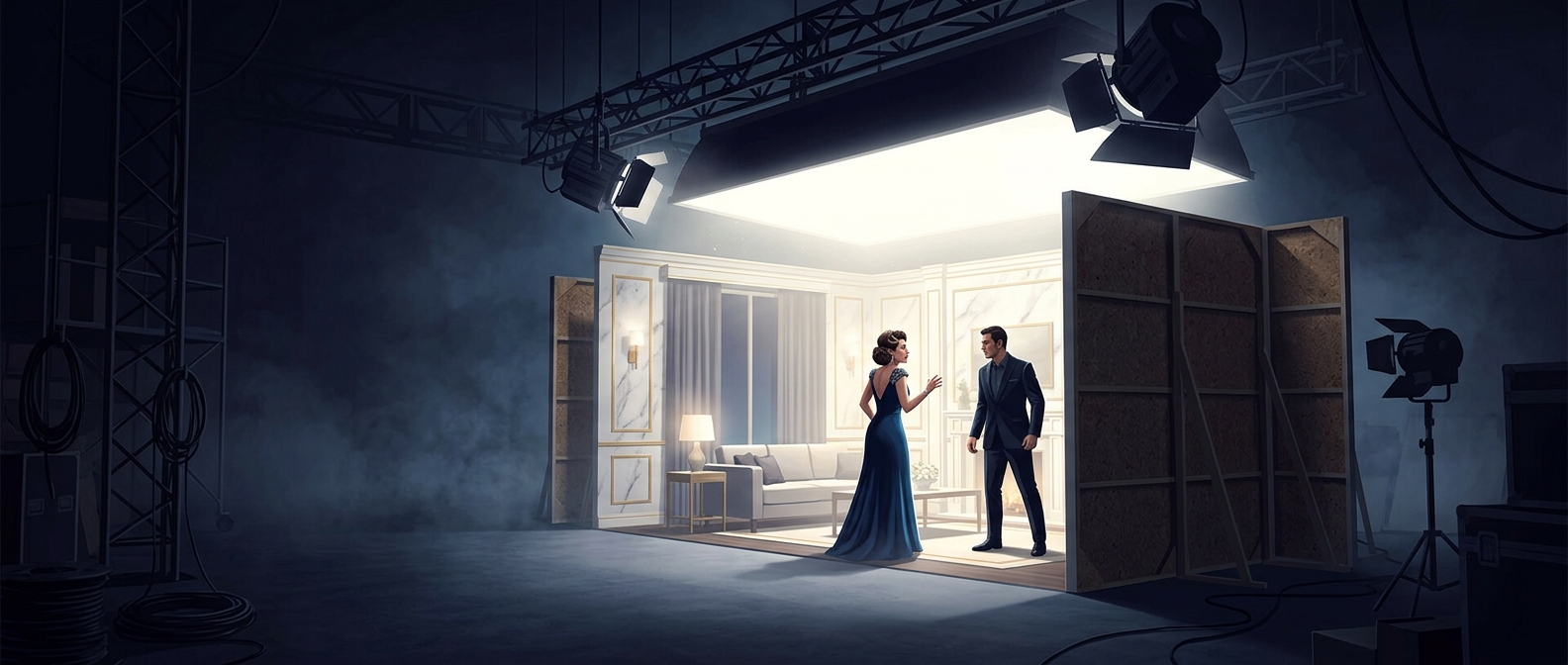
A bright set is not simply a matter of turning up every lamp. The useful trick is to keep light coming from many directions, so one strong source does not carve a hard shadow across a wall or a face. Softer, more even illumination lowers the contrast between lit and unlit areas. That makes small surface irregularities less conspicuous: a seam in a wallpaper pattern, an uneven paint job, or a slightly battered piece of furniture is less likely to announce itself in shadow.
The tradeoff: less drama, more flexibility
High-contrast lighting can make a room feel moody, but it also makes every shadow a design problem. A performer who moves a few feet may cross a sharply defined patch of darkness; a camera angle that works in one part of the scene may expose flaws elsewhere. With more uniform light, actors and cameras can move around a compact set with fewer changes to the lighting setup.
That flexibility matters when scenes must be filmed at a fast pace. The crew can spend less time reshaping light for each position, while the image remains bright and legible across the set. The result can look flatter than the carefully sculpted lighting of a feature film, but it supports the production's practical priorities: keep the scene moving, keep faces visible, and avoid drawing attention to a room that was built to serve the story rather than withstand close inspection.
The same light that smooths a wall also makes a modest set more forgiving from one shot to the next.