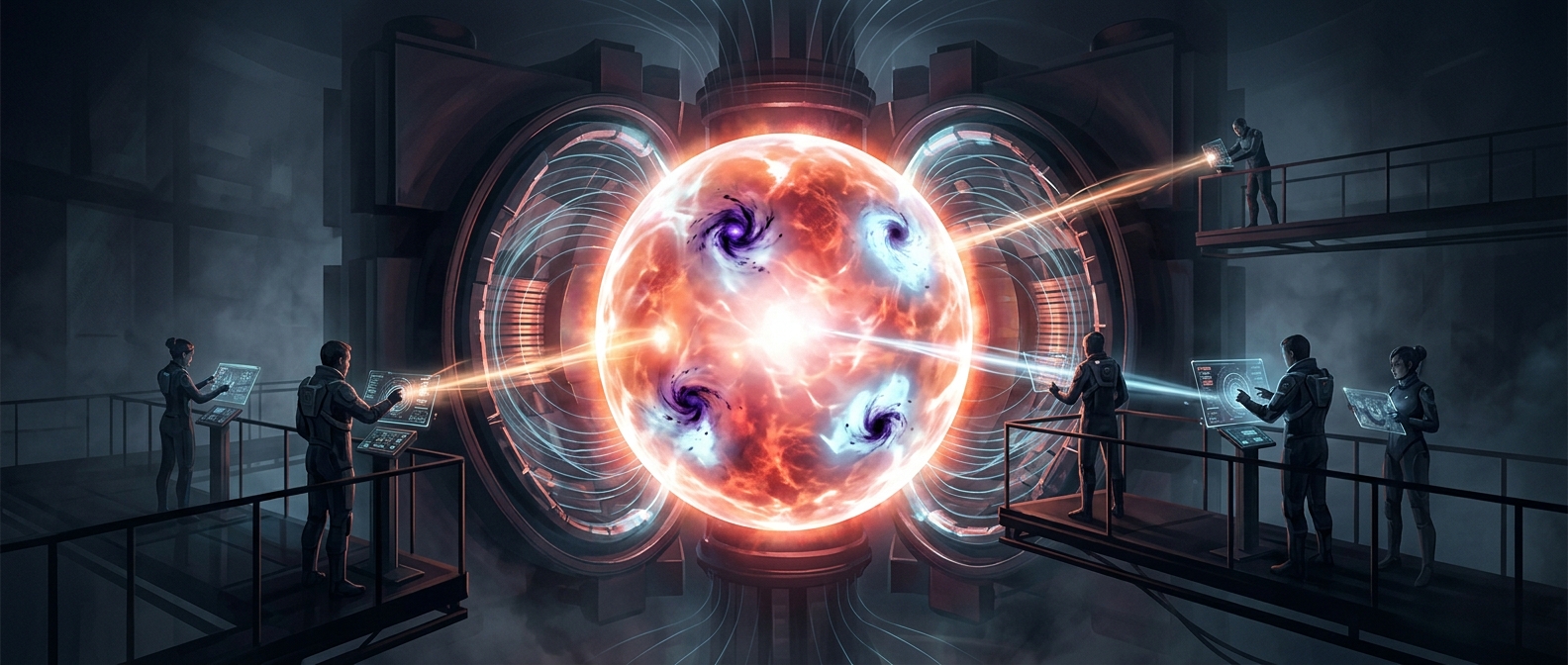
How a tiny fuel capsule becomes a fusion target
In inertial-confinement fusion, the fuel sits inside a small capsule. A powerful laser pulse heats the capsule’s outer layer so rapidly that material blows off its surface. The escaping material pushes the rest of the capsule inward, like a rocket moving opposite its exhaust. This implosion compresses and heats the fuel at the same time.
The challenge is keeping the implosion even. If one side caves in sooner, the fuel can squirt outward instead of reaching the pressure and temperature needed for many nuclei to fuse. The compression lasts only for an instant: the fuel’s own inertia holds it together briefly, before it expands and cools. That fleeting confinement is why the reaction can reach extreme temperatures without heating a large volume of material.
A hot spot is only one part of the test
Temperature describes how energetic the particles are, not how much fuel is reacting or how long it stays compressed. A useful fusion burst also needs enough fuel at high density for nuclei to collide, and enough confinement time for those collisions to produce substantial energy. Scientists therefore assess more than the peak temperature: the fuel’s conditions and the energy released from fusion matter too.
There is also a crucial boundary around any energy claim. Energy measured coming out of the fuel is not the same as electricity delivered by the entire facility. Lasers lose energy in converting electricity into light, and the experiment requires equipment beyond the capsule. A record-breaking temperature demonstrates that the fuel reached an extreme state; it does not, by itself, show that a power plant can run on fusion.