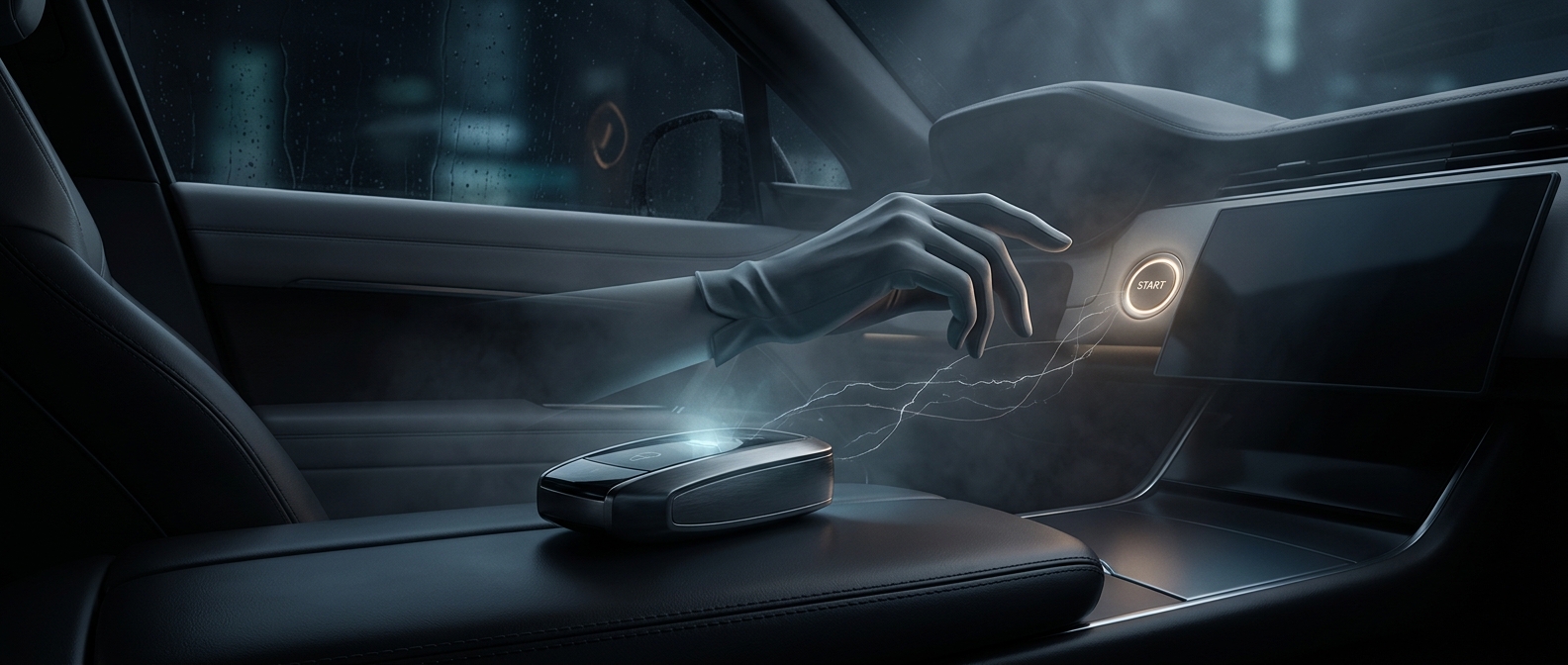
How the car recognizes a key in your pocket
A keyless ignition replaces the everyday act of inserting a metal key with an electronic check. When you press the start button, the car’s system looks for a nearby fob and verifies its coded signal. If the fob is recognized—and the car’s other start conditions are met—the system enables the engine or electric motor.
The fob is more than a remote control that sends one simple, reusable code. Keyless systems are designed to confirm that an authorized device is present, not merely that a button was pressed somewhere nearby. The result is a small shift in the driver’s routine: the key can stay in a pocket or bag while the car handles the check.
The metal key still has a backup job
“Keyless” does not always mean that a car contains no physical key. Many fobs conceal a small metal blade that can unlock the door if the fob’s battery is dead or the electronic entry system cannot be used. Some cars also provide a designated spot where a weak or dead fob can be held so the vehicle can detect it at very short range and start.
That backup matters because the convenience depends on electronics and power. The fob’s battery runs down; the car’s battery can fail; and radio interference can sometimes disrupt communication. The ordinary key has been demoted from the main interface, but a mechanical fallback may still be part of the design.
Convenience moves the task out of your hands
The change is less about eliminating the key than changing what the driver has to do. Instead of finding a key, putting it in a slot, and turning it, the driver carries an authorized fob and presses a button. That saves a small repeated effort, but it also makes the fob itself essential: lose it or leave it outside the car, and the start system has nothing to verify.
The striking part is how little the object seems to do. A fob resting in a pocket can authorize a vehicle without ever being visibly used; the old metal blade, when present, waits for the moment the electronics cannot.