A floating beacon has to hold its place
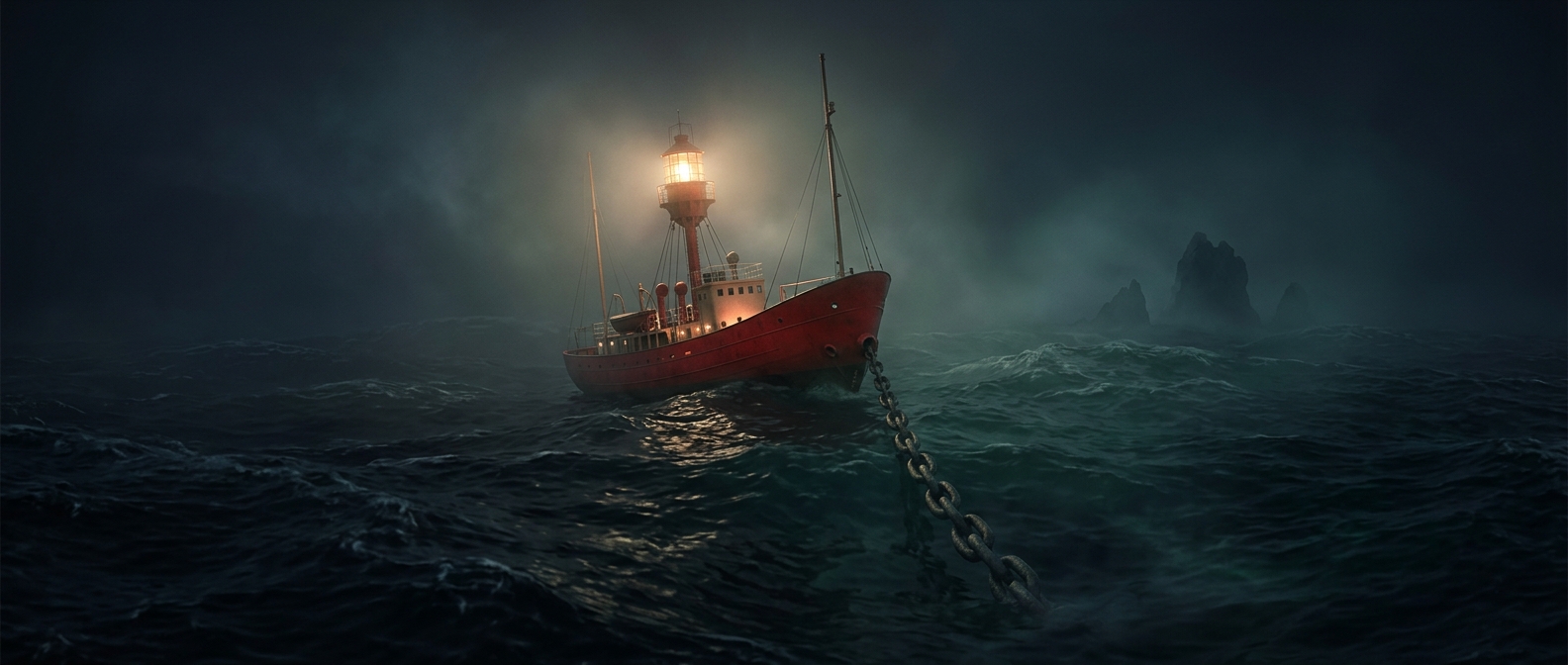
A lightship is useful where a fixed lighthouse would be difficult to build: offshore banks, shoals, or channels where ships need a warning but the water is too deep or the seabed too unsuitable for a tower foundation. The vessel can be taken to the needed location and moored there instead.
Its anchor does not pin it to one exact point. Wind and current make the ship swing around the anchor, so its position has to be chosen with that movement in mind. The anchor, chain, and seabed must keep the vessel from drifting into the very hazard it is marking. This is station-keeping by restraint, not by steering continuously against the weather.
The warning must work in more than clear weather
At night or in haze, a lantern or beacon gives approaching vessels a visible reference. In fog, when that light cannot be seen, a foghorn provides a sound signal instead. The signals help a navigator identify a dangerous area and judge where the ship is relative to it; they do not make the water safe or steer vessels around the hazard.
Because the lightship itself is the aid to navigation, its equipment must keep working while the vessel rides out changing conditions. That means maintaining the beacon and sound signal, as well as the mooring that holds the ship on station. A failure in either can leave mariners without the warning they expect at a critical stretch of water.
The lightship’s defining engineering tradeoff is simple: it can mark a location a tower cannot occupy, but it must continually withstand the forces that make that location hard to serve.