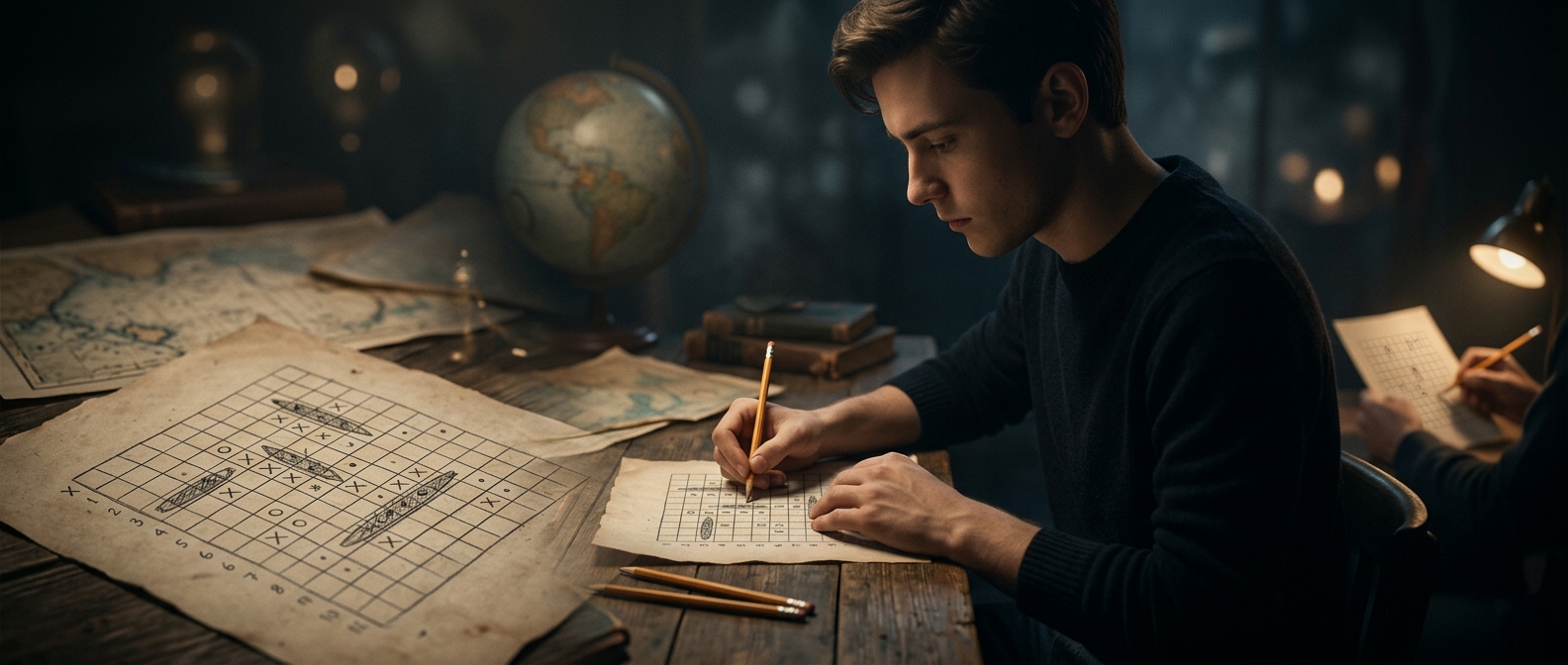
A grid turned scraps into a fleet
The paper version of Battleship needed almost nothing: two players, pencils, and a way to keep their pages out of each other’s sight. Each drew a grid, placed ships on it, then took turns calling out coordinates. A player marked each call on a separate tracking grid, recording whether it was a hit or a miss. The opponent kept the actual fleet’s location hidden.
That split between a private map and a public record did the work of a game board, ships, and referee. The rules could be carried in memory, while the paper preserved the information players needed from turn to turn. Muddy conditions might spoil a page, but the game did not depend on a particular set of pieces or a large, carefully arranged playing surface.
Why the simple version lasted
The grid made the game easy to start but left room for judgment. Players had to choose where to search, notice patterns in earlier calls, and decide how to follow up after a hit. A lucky guess could find a ship; a systematic search could narrow down where it might extend. The tension came from having enough information to make a plan, but never enough to see the whole board.
That compact design also made the game easy to adapt into a manufactured version. A boxed set could replace penciled grids with reusable boards and plastic ships, but the underlying contest remained the same: hide a fleet, track your guesses, and infer what the other player cannot see. In the trenches, a few marks on paper could create an entire naval battle without requiring a single toy ship.