Street art turns local history into a walk
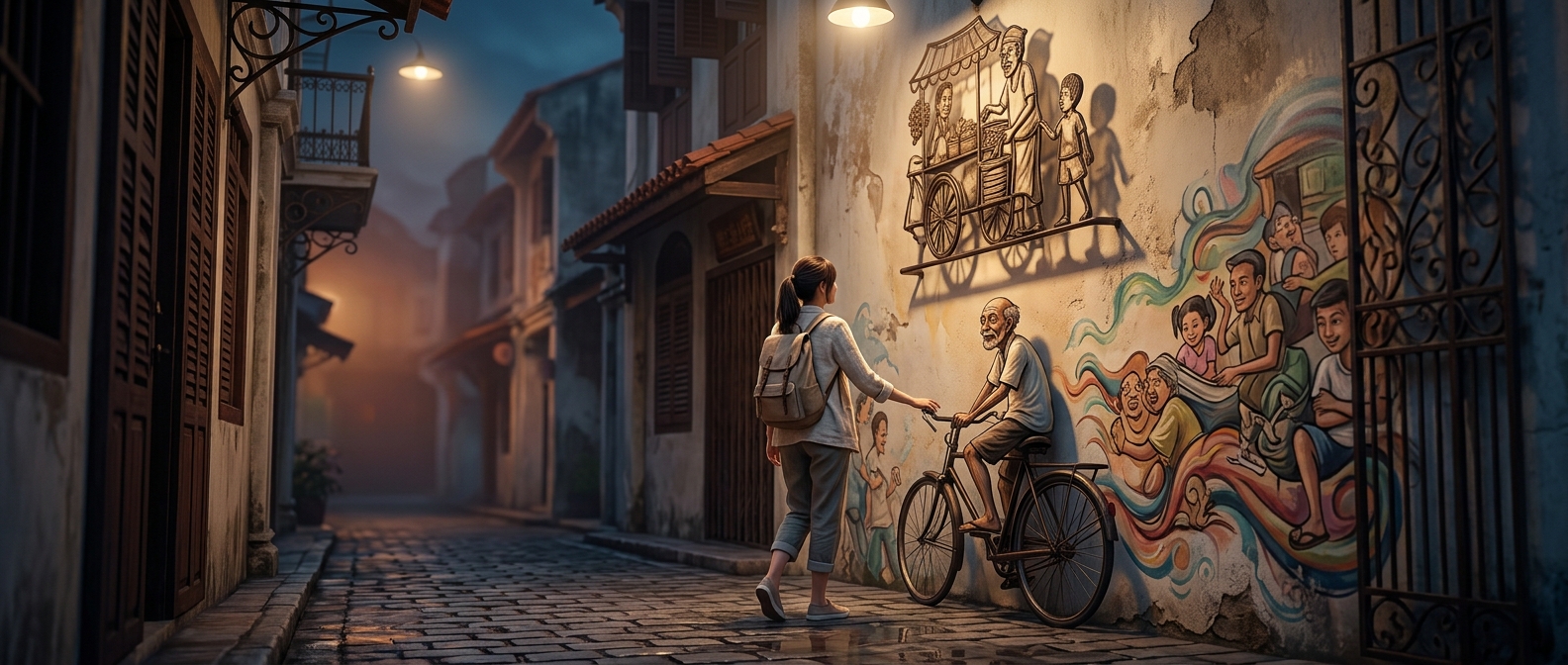
In George Town, the art is designed to be read against the streets around it. The welded-iron caricatures—curving metal figures paired with short captions—turn corners, shopfronts and old trades into bite-size stories. Their exaggerated shapes make them easy to notice, while their subjects point back to the people and everyday work that shaped the city. Rather than gathering the past in a museum, the installations let visitors encounter it while moving through the historic district.
That approach fits a city where conservation is not just about preserving individual buildings. George Town’s UNESCO-listed historic center is a lived-in urban landscape, and its identity depends on the relationship between architecture, street life and local memory. Public artworks give visitors a reason to look more closely at that setting instead of treating the old streets as a backdrop.
Murals make the viewer part of the scene
Ernest Zacharevic’s painted scenes work differently. Some combine paint on a wall with real objects, such as bicycles fixed in place, so a person can stand beside or on the object and appear to enter the picture. This is a form of trompe-l’œil—an image arranged to create the illusion of depth or physical interaction. The visitor’s pose completes the scene, turning looking into participation.
The two kinds of artwork therefore invite different kinds of attention: the iron pieces offer brief historical prompts, while the murals encourage people to stop, pose and photograph the result. Together, they make exploring the district less like following a formal exhibit and more like discovering stories along the way. A bicycle bolted to a wall is not merely decoration; it gives a passerby a role in the picture—and a reason to notice the street that frames it.