The slot turns a sliding joint into a lock
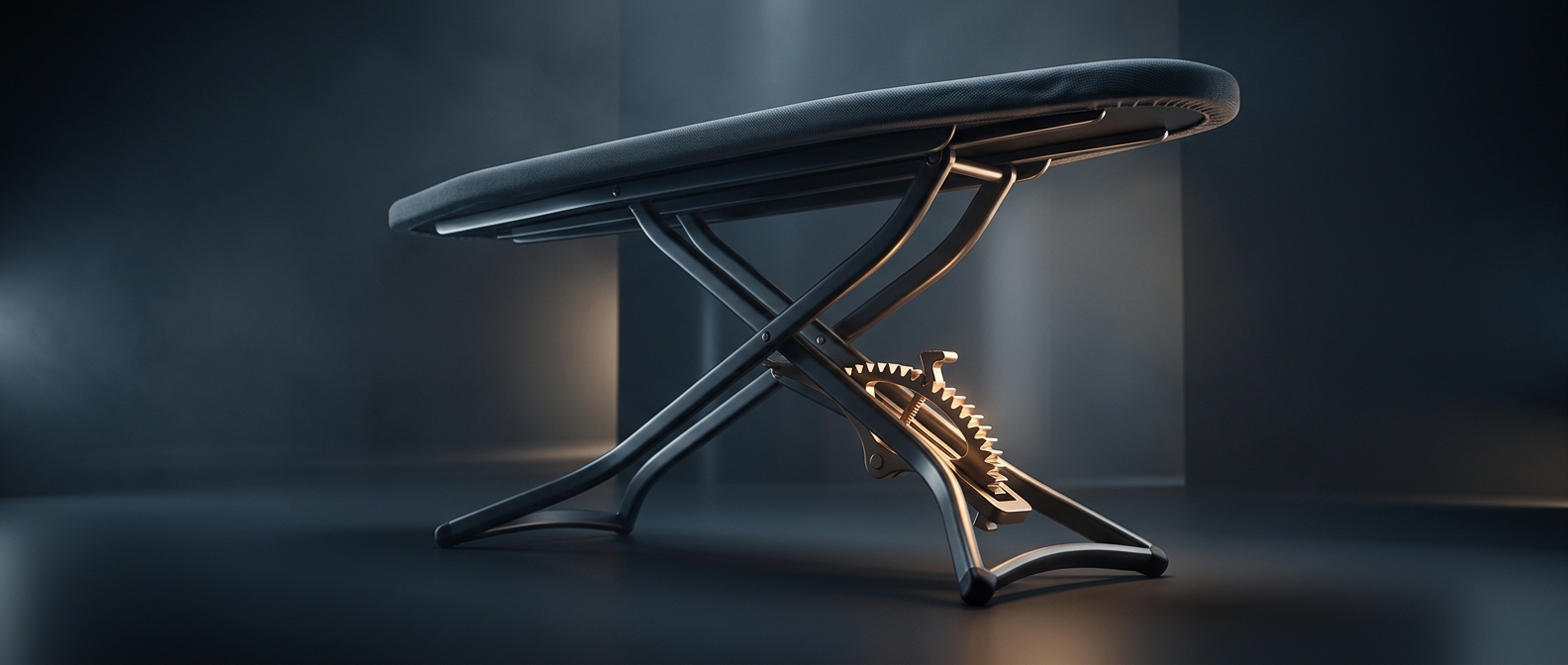
An ironing board’s crossed legs form a scissor mechanism: as the legs pivot, their upper ends spread to support the board and their lower ends shift along the floor. A metal rod linked to the legs moves through a notched track as the board opens. Pulling the handle lifts the rod clear of the notches, allowing the legs to move; letting go seats it in a notch at the chosen position.
The notches matter because they give the rod fixed places to catch. Rather than asking a smooth sliding part to stay put through friction alone, the mechanism uses metal-on-metal contact to resist the rod moving back along the track. The board’s height is therefore set by which notch holds the leg linkage.
Why the board stays open
When someone presses down on the ironing surface, the force travels through the board into the crossed legs. Their pivots and the locked rod-and-track joint constrain the legs from folding inward. To close the board, the user releases the rod from its notch and reverses the motion.
This simple arrangement combines two jobs: the crossed legs let the board collapse for storage, while the notched track gives it a series of stable open positions. The same feature that makes height adjustment possible also provides the catch that keeps the legs from scissoring shut during use.