How a Hand Drill Trades Force for Speed
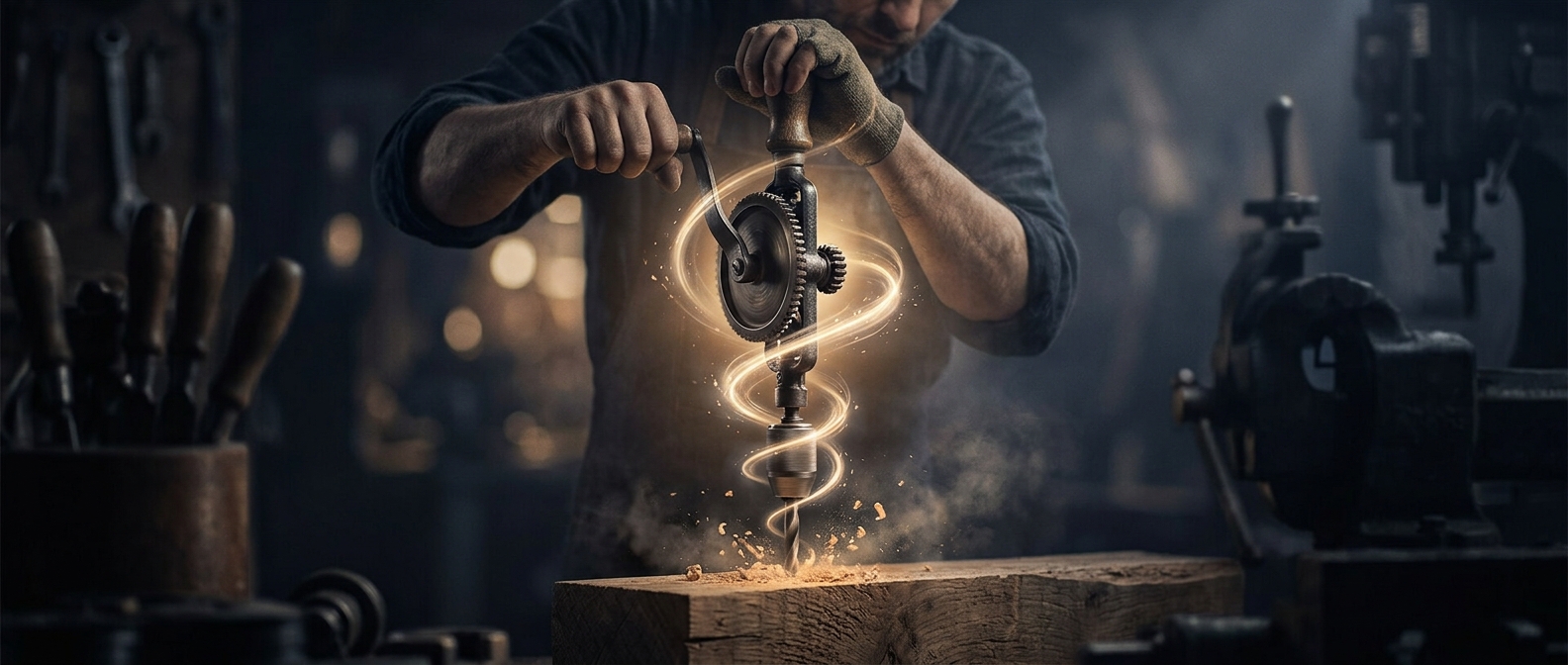
A crank turns the large gear, whose teeth push against the teeth of a smaller gear connected to the chuck—the clamp that holds the bit. Because the smaller gear has fewer teeth, it must turn through more rotations to keep pace with the larger gear’s movement. The result is that one turn of the crank can produce several turns of the bit.
The gears also redirect the motion: the crank and large gear rotate around one axis, while the smaller gear and chuck spin around a perpendicular axis. That lets the user turn a side-mounted handle while the bit points forward into the material.
Why the Gear Size Matters
The gear ratio sets the balance between speed and turning force. A smaller driven gear spins faster, but it provides less torque—the twisting force that helps a bit bite into wood or another material. The user supplies the effort at the crank, and the gearing converts that effort into quicker rotation at the chuck.
This is why a hand drill can make a bit spin rapidly without a motor, but still asks the user to push steadily and keep the bit aligned. The gears do not create energy; they exchange some turning force for more rotations.