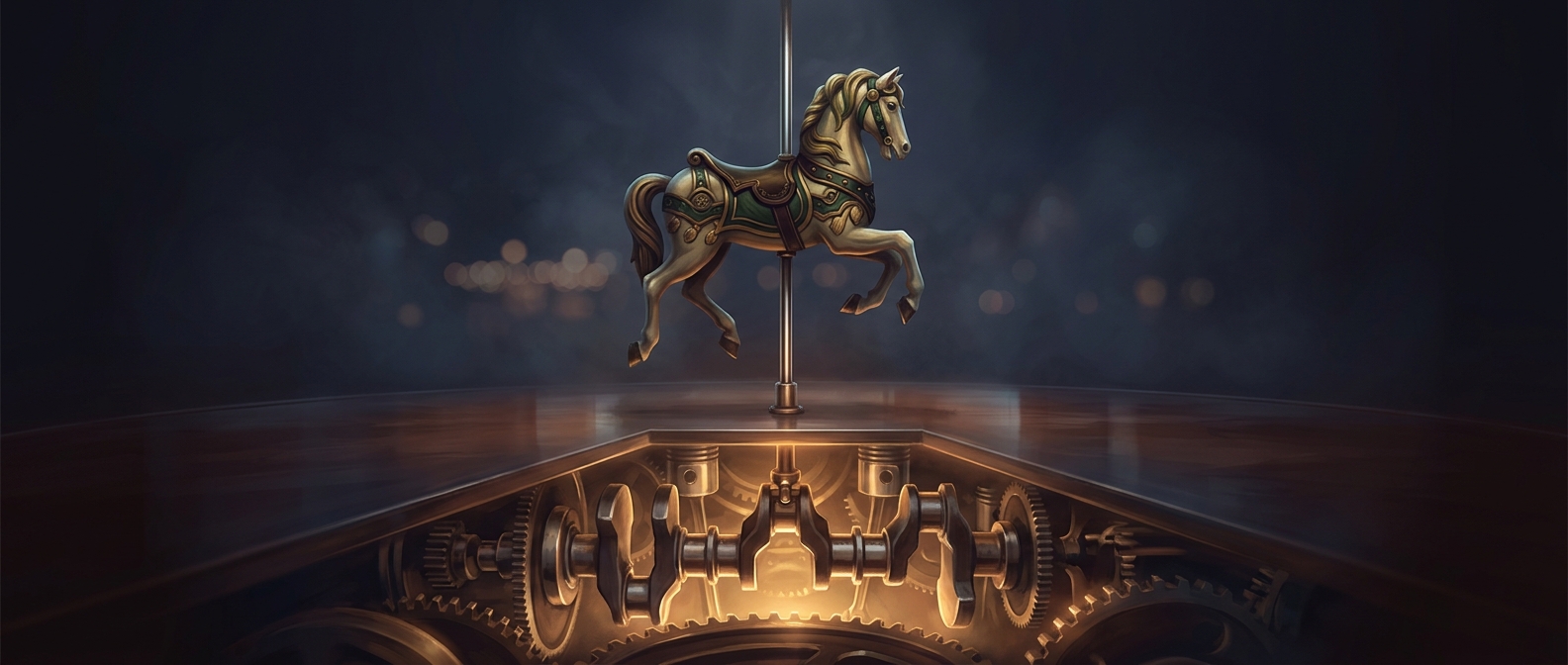
The crank turns rotation into a bounce
A carousel motor supplies steady rotation, but a horse’s gallop requires a different motion: repeated up-and-down travel. The machine bridges that gap with an offset crank—a rotating pin set away from the center of a wheel or disk. As the pin circles, it pushes and pulls a connecting rod, which moves vertically in a repeating cycle.
The farther the crank pin sits from the center, the larger the rod’s stroke. The carousel’s speed sets how quickly that stroke repeats. Together, those choices determine whether the horse rises and falls in a lively rhythm or a gentler one.
The horse is guided, not rocked
The rod acts on the horse’s mounting pole, which slides through guides in the carousel structure. Those guides keep the pole traveling up and down instead of tipping sideways. Meanwhile, the rotating platform carries the horse around the carousel’s central axis. The two motions happen at once: the horse circles the ride while its pole follows the crank’s vertical cycle.
That distinction is what makes the movement look like a gallop rather than a horse simply being lifted. The mechanism repeats the same controlled path on every revolution, so the apparent stride is regular and synchronized with the ride. A small, hidden change in the linkage’s motion becomes the most animated part of the carousel’s display.